Fine Detail Blue LightJewelry Precision ScanningMiniature Detail CaptureSmall Object DigitizationFull Color Detail ScanHigh Precision Micro Scanning
33DMakerpro
3DMakerpro
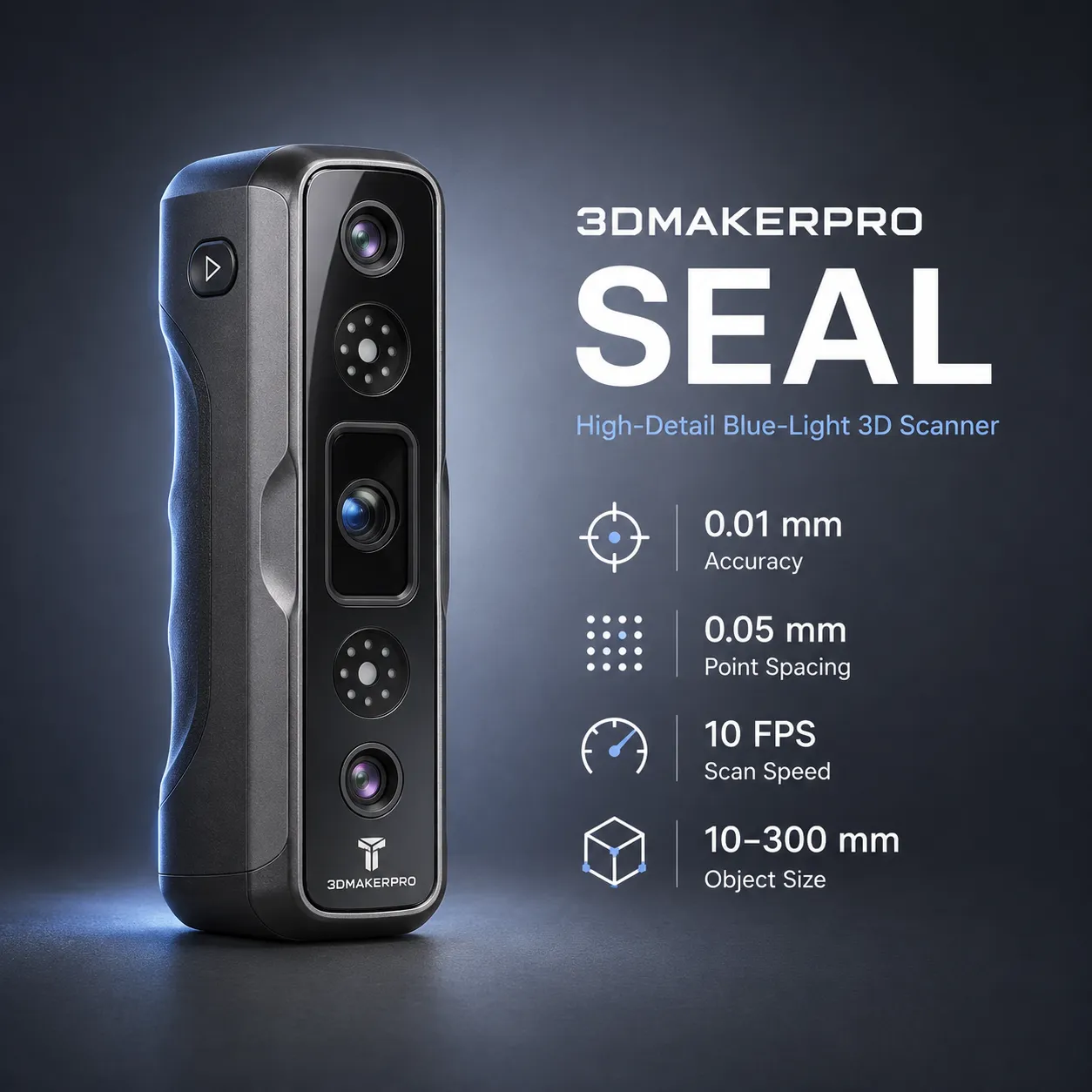
# 3DMakerpro Seal
The 3DMakerpro Seal is a compact blue-light structured-light 3D scanner built for small objects where fine geometry and color matter more than wide-area coverage. Its strongest uses include jewelry, miniatures, collectibles, decorative objects, small mechanical parts, product digitization, and scan-to-print workflows.
3DMakerpro publishes up to 0.01 mm accuracy, 0.05 mm minimum point spacing, a 100 × 75 mm single-capture area, and a typical object-size range of approximately 10–300 mm. Seal scans at up to 10 FPS and acquires up to 100,000 points per second.
The scanner also includes a dedicated texture camera for 24-bit color capture, marker-free visual tracking, optical anti-shake stabilization, and nine levels of light adjustment. At 254 g, its aluminum-alloy body is light enough for handheld use and can also be mounted on a tripod or used with optional accessories.
For current specifications and availability, see the official 3DMakerpro Seal page. Current scanning software and export information is available on the official JMStudio page.
| Specification | Value |
|---|---|
| Scanning technology | Blue-light encoded structured light |
| Manufacturer-stated accuracy | Up to 0.01 mm |
| Minimum point spacing | 0.05 mm |
| Scan rate | Up to 10 FPS |
| Point acquisition | Up to 100,000 points/s |
| Tracking | Visual tracking |
| Working distance | 180–280 mm |
| Single-capture area | 100 × 75 mm |
| Typical object size | 10–300 mm |
| Color capture | 24-bit texture |
| Base scanner interface | USB 2.0 |
| Software | JMStudio |
| Dimensions | 110 × 60 × 35 mm |
| Weight | 254 g |
| Housing | Aluminum alloy |
Accuracy note: The 0.01 mm accuracy and 0.05 mm point spacing figures describe different characteristics. Point spacing is not dimensional accuracy.
Surface note: Transparent, mirror-like, strongly reflective, hairy, or otherwise optically difficult surfaces may require scanning spray or other preparation.
Seal uses a blue-light encoded structured-light system rather than laser-line scanning. 3DMakerpro describes the projected wavelength range as approximately 400–500 nm, with the optical setup optimized for fine-detail capture at close working distances.
The scanner's main geometry specifications are:
This makes Seal better suited to small objects than to cars, furniture, rooms, or other large-format subjects.
For a broader professional reverse-engineering workflow, compare the Revopoint MetroX Pro or Creality CR-Scan Raptor Pro.
3DMakerpro lists a typical object-size range of approximately 10–300 mm.
That range suits rings, pendants, miniatures, figurines, carved pieces, decorative parts, product housings, and small mechanical components.
The 100 × 75 mm single-capture area means larger objects within the recommended range are reconstructed from multiple overlapping views.
Seal is especially relevant to jewelry-sized subjects because its point spacing and close working distance concentrate capture on small features. Polished metal, transparent stones, mirrors, or other highly reflective surfaces may still require temporary matte coating.
Seal uses visual tracking rather than adhesive tracking markers during normal scanning.
This simplifies capture of objects with enough distinctive geometry or texture for the software to maintain alignment.
Visual tracking can become more difficult on:
For challenging small parts, a turntable or controlled scanning path can improve tracking consistency.
Seal includes a dedicated 24-bit color texture camera.
Color capture is useful for collectibles, artwork, cultural objects, decorative products, digital assets, and product visualization.
For reverse engineering, color texture remains separate from geometric accuracy. A visually detailed texture does not make a model dimensionally validated.
3DMakerpro equips Seal with an anti-shake optical system designed to reduce the effect of small hand movements during handheld scanning.
The scanner also provides nine levels of light adjustment to help adapt exposure for differently colored or reflective subjects.
These features improve usability but do not eliminate the need to maintain correct working distance, steady motion, adequate overlap, and suitable surface preparation.
At 254 g, Seal is light enough for handheld scanning.
For jewelry, miniatures, and small mechanical parts, a fixed setup can be more repeatable. The scanner can be used with a tripod or optional turntable.
3DMakerpro also sells an optional Smart Grip for smartphone-assisted scanning.
The Smart Grip adds:
The Smart Grip is an accessory, not part of the base Seal hardware.
Important: The base Seal should not be described as a wireless or battery-powered scanner. Its normal hardware interface is USB 2.0.
Seal uses JMStudio, 3DMakerpro's scanning and processing software.
Current functions include:
The Seal product page lists:
The broader JMStudio platform also supports RSCAN, but the structured scanner file list remains limited to the formats explicitly listed for Seal.
For current downloads and system requirements, see JMStudio.
Seal can create detailed mesh references for 3D printing and small-scale reverse engineering.
A typical scan-to-print workflow is:
A raw scan is not automatically a parametric CAD model. Engineering work normally requires dimensional checks against the physical part and, when needed, CAD reconstruction.
For broader guidance, see Best 3D Scanners for Reverse Engineering in 2026 and 3D Scanner Accuracy vs Resolution.
| Scanner | Main Strength | Published Accuracy | Positioning |
|---|---|---|---|
| 3DMakerpro Seal | Small-object detail and color | Up to 0.01 mm | Jewelry, miniatures, scan-to-print |
| MetroX Pro | Blue-light reverse engineering | Up to 0.02 mm | Professional engineering parts |
| CR-Scan Raptor Pro | Hybrid laser/NIR scanning | Up to 0.02 mm blue laser | Engineering and wider object sizes |
| MIRACO Plus | Standalone scanning | Up to 0.04 mm | Portable all-in-one workflow |
Seal's published accuracy is unusually strong for a consumer small-object scanner, but its visual tracking, small capture area, 10 FPS rate, and USB-centered workflow make it different from professional metrology-oriented laser scanners.
3DMakerpro currently identifies Seal as a 2024 Edison Awards Silver winner on its official product page.
This supports the existing `"AWARD WINNER"` catalog label.
Recommended use: Choose 3DMakerpro Seal when fine geometry and color on jewelry, miniatures, collectibles, detailed mechanical components, and other small objects matter more than large capture area or high scanning speed.
Blue-light encoded structured-light scanning.
3DMakerpro publishes accuracy up to 0.01 mm.
The manufacturer specifies 0.05 mm minimum point spacing.
Up to 10 FPS and approximately 100,000 points per second.
180–280 mm.
Approximately 10–300 mm.
It uses visual tracking and normally operates without adhesive markers.
Yes. It supports 24-bit color texture capture.
Yes. Jewelry and other small detailed objects are among its strongest applications, although polished or reflective surfaces may require preparation.
JMStudio.
STL, OBJ, PLY, and ASC are listed for Seal.
Yes, when paired with the optional Smart Grip and a compatible Android or iOS device.
The base scanner is not wireless. It uses USB 2.0; mobile operation is provided through the optional Smart Grip.
The official US store lists Seal at US$699.