Sinterable 316L Stainless SteeMetal FFF Engineering FilamentDebind-And-Sinter Metal FeedstockHigh-Density Stainless Steel FilamentIndustrial Metal Composite FilamentCorrosion-Resistant 316L Material
FForward AM
Forward AM
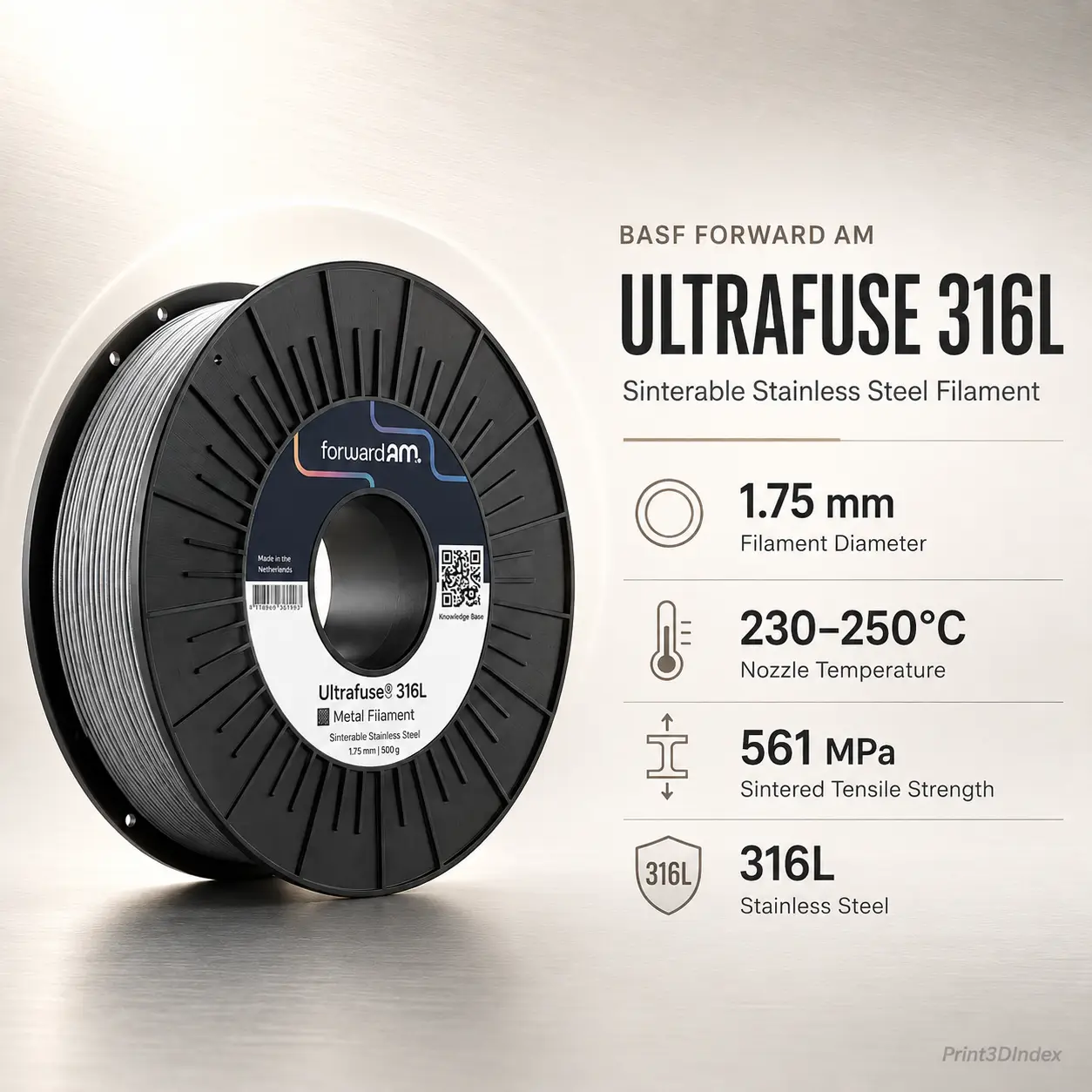
# BASF Forward AM Ultrafuse 316L
BASF Forward AM Ultrafuse 316L is a highly metal-filled composite filament for producing 316L stainless-steel parts by FFF printing followed by catalytic debinding and sintering.
The filament itself is not the finished metal. The printer creates a polymer-bound green part containing about 88% 316L stainless-steel particles and 12% polymer binder. Professional debinding removes the binder, producing a fragile brown part, and sintering then consolidates the metal into the final stainless-steel component.
The attraction of Ultrafuse 316L is that users can print metal feedstock on suitable FFF hardware rather than operating loose metal-powder equipment. The trade-off is a more complex process chain: parts must be designed for anisotropic shrinkage, printed with controlled settings, debound, sintered, and often finish-machined.
For current manufacturer information, see the official Ultrafuse 316L page, the Forward AM Metal Solution guide, and Forward AM debinding and sintering resources.
| Specification | Value |
|---|---|
| Material type | 316L stainless-steel / polymer composite filament |
| Printing process | Metal FFF / FDM |
| Final material | AISI 316L / UNS S31603 stainless steel after D&S |
| Metal loading | Approx. 88% 316L stainless steel / 12% polymer binder |
| Diameter | 1.75 mm |
| Spool size | 3 kg |
| Nozzle temperature | 230–250°C |
| Bed temperature | 90–100°C in current TDS |
| Chamber temperature | Not required; enclosure recommended to reduce airflow |
| Nozzle diameter | ≥0.4 mm |
| Print speed | 15–50 mm/s |
| Typical test speed | 25 mm/s |
| Part cooling | Off |
| Drying | Not required |
| Bed | Glass + approved adhesive / polyimide tape |
| Recommended nozzle | Clean hardened nozzle preferred |
| Green-part scaling | About 120% XY / 124% Z starting scale factors |
| Typical shrinkage | About 16% XY / 20% Z |
| Recommended new-user part size | Around 60 × 60 × 60 mm or smaller |
| Typical maximum green-part footprint | 100 × 100 × 100 mm before special arrangements |
| Recommended minimum wall | About 1 mm |
| Sintered density | 7.85 g/cm³ |
| XY tensile strength | 561 MPa |
| ZX tensile strength | 521 MPa |
| XY yield strength | 251 MPa |
| ZX yield strength | 234 MPa |
| XY elongation at break | 53% |
| ZX elongation at break | 36% |
| XY notched Charpy impact | 111 kJ/m² |
| Vickers hardness | 128 HV10 |
| Post-processing | Catalytic debinding + sintering mandatory |
Mechanical values apply to correctly debound and sintered test specimens, not the printed green part.
Users searching for Ultrafuse 316L print settings, BASF Ultrafuse 316L temperature, or 316L metal filament settings should start from Forward AM's current documented process window:
Forward AM's test specimens used a 0.4 mm nozzle, 245°C nozzle temperature, 100°C bed, and 25 mm/s print speed.
A fully enclosed chamber is recommended to reduce airflow and warping, but active chamber heating is not essential in the manufacturer's general metal-filament guidance.
High metal loading increases nozzle wear. Forward AM recommends a new, clean nozzle and prefers hardened nozzles for longer life; brass can work but should be replaced regularly, roughly after a 3 kg spool. The heavy 3 kg spool also benefits from a low-friction bearing-supported holder to avoid feed drag.
One of the most important design topics is Ultrafuse 316L shrinkage.
Forward AM's general guidance uses approximately:
These are process starting points, not guaranteed compensation values. Actual shrinkage depends on geometry, wall thickness, print orientation, extrusion strategy, support design, furnace cycle, and the debinding/sintering provider.
Dimensionally critical parts should be calibrated using representative geometry and the exact D&S workflow intended for production.
The printed green part contains stainless-steel powder in polymer binder. Catalytic debinding produces a fragile brown part, and sintering consolidates it into the final dense 316L component. Published strength, hardness, elongation, and density apply only after sintering; the 561 MPa tensile figure is not a green-part property.
Catalytic debinding and sintering are mandatory. Forward AM currently references specialist D&S partners including Elnik Systems and DSH Technologies. The practical chain is design with shrinkage compensation, print, debind, sinter, inspect, then machine or finish as needed. Tight-tolerance features and threads commonly require final machining.
Forward AM recommends starting around a 60 mm cube or smaller. Standard D&S handling typically limits green parts to about 100 × 100 × 100 mm, with roughly 1 mm minimum walls, stable flat bases, and height-to-width ratios below about 3:1 where possible. Larger parts need special arrangements and carry more warping risk.
For geometries that require printed support, Forward AM developed Ultrafuse Support Layer as an interface material between metal supports and the part so the support does not fully sinter to the component.
The final material is 316L stainless steel, an austenitic grade valued for corrosion resistance and ductility. It suits tooling, fixtures, prototypes, and custom stainless components; 17-4 PH is the stronger/harder alternative when ductility is less important.
The Ultrafuse 316L vs 17-4 PH comparison is corrosion resistance and ductility versus strength and hardness.
| Property | Ultrafuse 316L | Ultrafuse 17-4 PH |
|---|---|---|
| Tensile strength | 561 MPa XY | About 760 MPa XY |
| Yield strength | 251 MPa XY | About 680 MPa XY |
| Elongation at break | 53% XY | About 4% XY |
| Hardness | 128 HV10 | About 257 HV10 |
| Corrosion positioning | Excellent | Good |
| Magnetic | Austenitic / generally non-magnetic | Magnetic |
| Heat-treatable for strength | No precipitation hardening | Yes |
Choose Ultrafuse 316L for corrosion resistance, ductility, stainless tooling, and general 316L components.
Choose Ultrafuse 17-4 PH when high strength, hardness, and precipitation-hardening capability matter more.
The Ultrafuse 316L vs DMLS or metal filament vs powder-bed fusion comparison is about process accessibility rather than one universally superior technology.
Ultrafuse Metal FFF avoids loose powder and can use suitable FFF hardware, but it adds mandatory D&S, anisotropic shrinkage, size constraints, logistics, and possible finish machining. DMLS/SLM consolidates powder directly and has a broader production ecosystem, but needs much more expensive equipment, powder handling, inert gas, and specialized facilities.
For organizations without powder-metal infrastructure, Metal FFF historically offered a lower-barrier route when D&S could be outsourced.
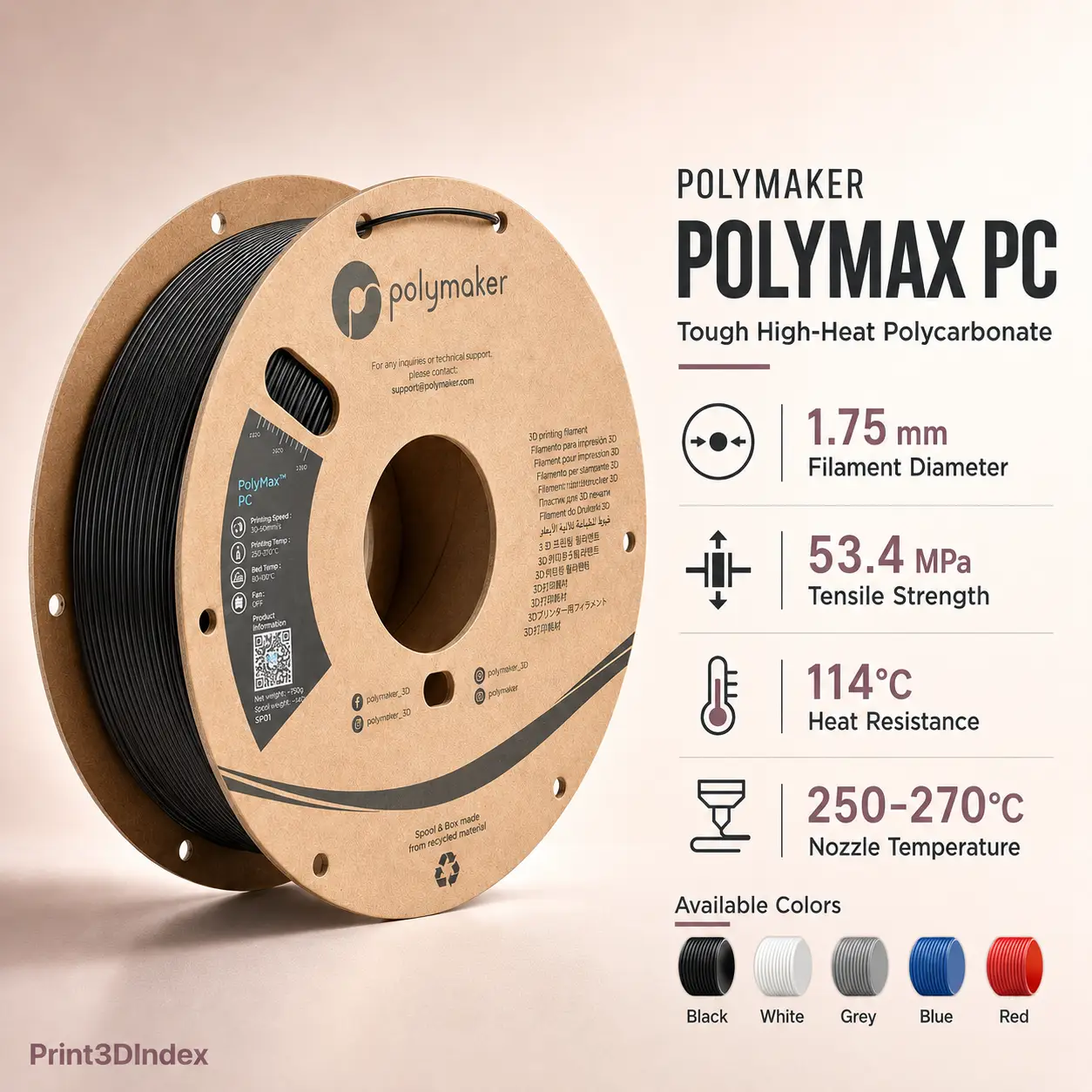
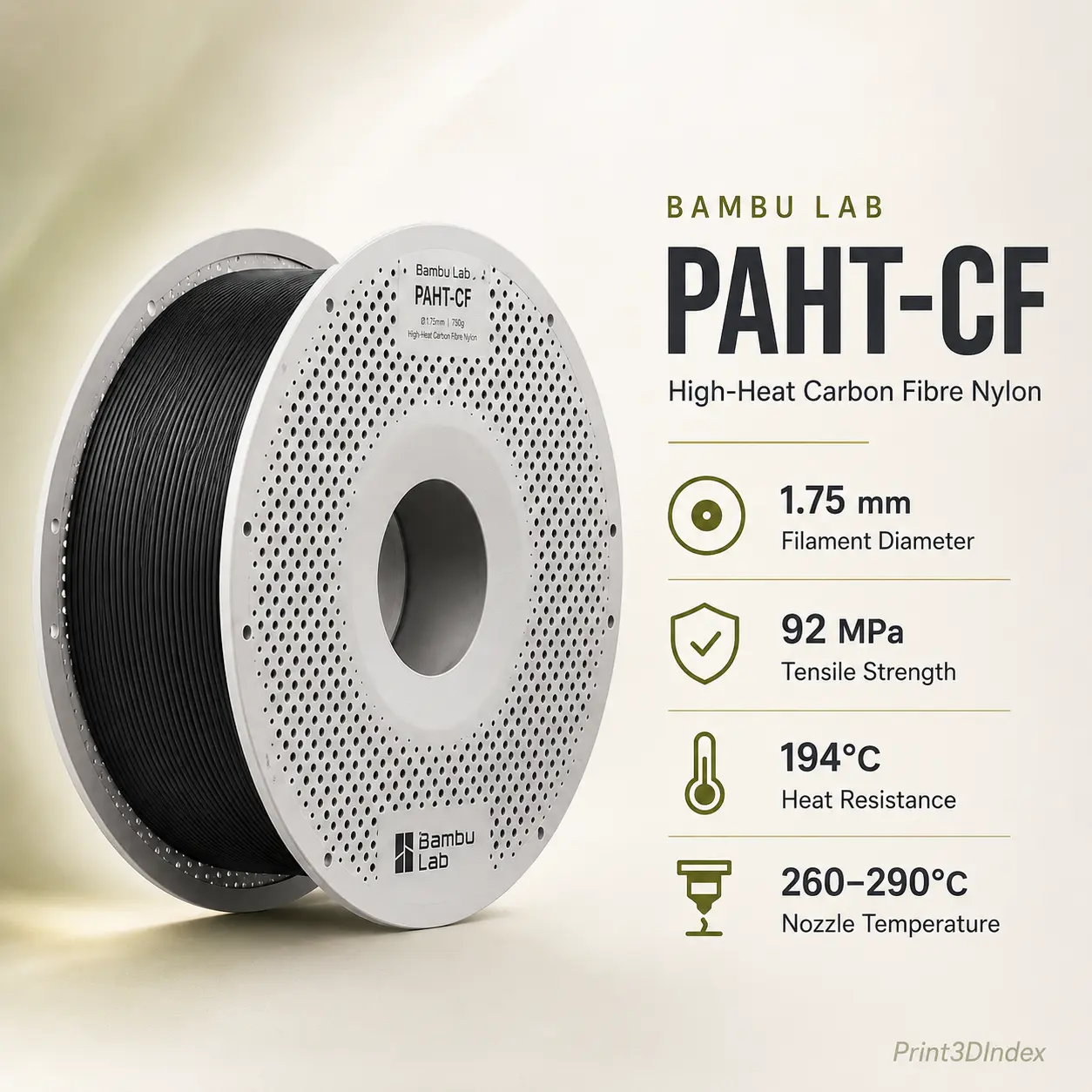
The indexed Bambu Lab PPS-CF, Bambu Lab PAHT-CF, and Polymaker PolyMax PC are relevant only when a project can use a high-performance polymer instead of metal.
| Material | Final material | Process | Main advantage |
|---|---|---|---|
| Ultrafuse 316L | Sintered 316L stainless steel | Print + catalytic debind + sinter | True metal, corrosion resistance, ductility |
| Bambu PPS-CF | Carbon-fiber PPS | Direct FDM | Extreme heat/chemical polymer performance |
| Bambu PAHT-CF | Carbon-fiber long-chain PA | Direct FDM | Tough, low-moisture engineering nylon |
| PolyMax PC | Polycarbonate | Direct FDM | Tough, non-abrasive engineering PC |
Choose polymers for direct printing, lower mass, and faster iteration; choose Ultrafuse 316L when the final material must be 316L stainless steel.
The Ultrafuse 316L vs PPS-CF comparison is true stainless steel versus an extreme-temperature polymer composite.
The indexed Bambu Lab PPS-CF offers 264°C HDT at 0.45 MPa and direct FDM processing. Choose PPS-CF when a high-performance polymer is acceptable; choose Ultrafuse 316L when stainless-steel behavior is required.
The indexed Bambu Lab PAHT-CF offers 194°C HDT at 0.45 MPa and direct FDM production. Choose PAHT-CF for strong polymer fixtures and tooling; choose Ultrafuse 316L when the part must be metal.
For users searching Ultrafuse 316L price, 316L filament price, or metal filament cost, Raise3D currently lists the 1.75 mm / 3 kg spool at US$464.99.
That is approximately:
Finished-part cost also includes printing, nozzle wear, support/adhesive, D&S, shipping, inspection, and machining.
Raise3D currently lists Ultrafuse 316L 1.75 mm / 3 kg at US$464.99. For regional reference, that is approximately €397.86 in Europe, £341.01 in the UK, AED 1,707.68 in the UAE, C$639.33 in Canada, A$649.08 in Australia, ₹44,491 in India, ¥73,855 in Japan, and ¥3,126.24 in China. Actual pricing may vary by region, tax, shipping, stock, promotions, and exchange rates.
It is a metal-filled composite filament used to print green parts that become 316L stainless steel after catalytic debinding and sintering.
Yes. Forward AM's current product page marks it discontinued, although documentation, D&S resources, and remaining distributor stock still exist.
230–250°C.
The current TDS lists 90–100°C.
At least 0.4 mm. A clean hardened nozzle is preferred for longer life.
Forward AM recommends a fully enclosed chamber to reduce airflow and warping, although active chamber heating is not essential.
No. Forward AM states that it is supplied ready to print when stored correctly.
About 16% in X/Y and 20% in Z as a general Forward AM guideline.
561 MPa in XY and 521 MPa in ZX for the documented test specimens.
No. Final stainless-steel properties are achieved only after debinding and sintering.
316L prioritizes corrosion resistance and ductility; 17-4 PH provides much higher strength and hardness and can be precipitation hardened.
No. Metal FFF prints a binder-filled green part that must be debound and sintered. DMLS/SLM fuses metal powder directly with a laser.
Raise3D currently lists a 1.75 mm / 3 kg spool at US$464.99, excluding D&S and finishing costs.