Tough High-Heat PolycarbonateImpact-Resistant Engineering PCVibration-Resistant PC FilamentAnnealable Polycarbonate MaterialHigh-Stability Functional PCEnclosed-Printer Engineering Filament
PPolymaker
Polymaker
# Polymaker PolyMax PC
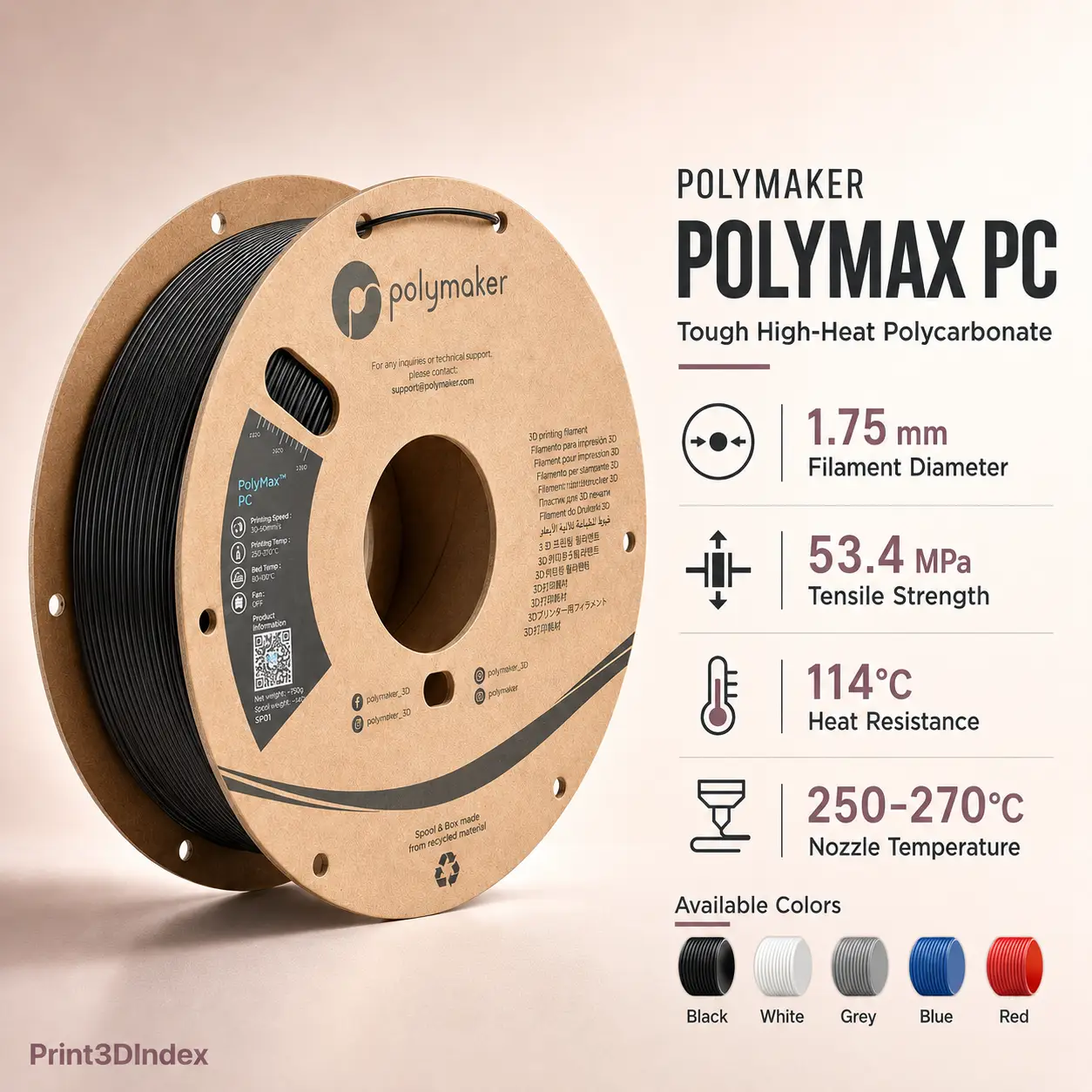
Polymaker PolyMax PC is a 1.75 mm engineering-grade polycarbonate filament developed for tough, heat-resistant functional parts, jigs, fixtures, housings, tooling, and end-use components. It is one of Polymaker's tougher PC formulations, prioritizing impact resistance and layer strength while still printing at a lower nozzle temperature than many traditional polycarbonate materials.
The current 2026 technical data sheet reports 53.44 ± 0.60 MPa XY tensile strength, 21.28 ± 1.69 kJ/m² notched Charpy impact strength, 114°C HDT at 0.45 MPa, and 99°C HDT at 1.8 MPa. PolyMax PC is also non-abrasive, so it does not require a hardened nozzle solely because of the filament.
Polycarbonate printing is substantially more demanding than PLA, PETG, or ordinary ABS. Polymaker currently requires an enclosed printer that can retain heat and strongly recommends an actively heated chamber of at least about 70°C, particularly for large or dense parts. Annealing immediately after printing is also recommended to reduce residual stress and layer cracking.
The material is especially relevant to users searching for PolyMax PC filament, polycarbonate filament for engineering, high-temperature PC filament, heat-resistant filament, and tough PC filament where impact resistance matters as much as stiffness.
For current manufacturer information, see the official PolyMax PC product page, official PolyMax PC technical data, and current US store listing.
| Specification | Value |
|---|---|
| Material | Engineered polycarbonate filament |
| Printing process | FDM / FFF |
| Diameter | 1.75 mm |
| Current spool sizes | 0.75 kg / 3 kg |
| Colors | Black / White / Grey / Blue / Red |
| Nozzle temperature | 250–270°C |
| Bed temperature | 90–105°C |
| Print speed | 50–200 mm/s |
| Cooling fan | Off |
| Enclosure | Required |
| Heated chamber | Strongly recommended; ~70°C minimum recommended |
| Drying | 75°C for 6 hours if moisture has been absorbed |
| Annealing | 90°C for 2 hours |
| Recommended build surfaces | PC / Textured PEI |
| Density | 1.19 g/cm³ |
| Equilibrium water absorption | Approx. 0.253% at 23°C / 70% RH |
| Glass transition temperature | 113°C |
| Melting temperature | Not reported in current TDS |
| Decomposition temperature | 360°C |
| Vicat softening temperature | 117°C |
| HDT at 0.45 MPa | 114°C |
| HDT at 1.8 MPa | 99°C |
| XY tensile strength | 53.44 ± 0.60 MPa |
| Z tensile strength | 41.43 ± 1.50 MPa |
| XY Young's modulus | 2435 ± 63 MPa |
| Z Young's modulus | 2149 ± 119 MPa |
| XY elongation at break | 4.53 ± 0.45% |
| Z elongation at break | 2.79 ± 0.21% |
| XY bending strength | 81.29 ± 1.53 MPa |
| XY bending modulus | 2050 ± 79 MPa |
| XY notched Charpy impact | 21.28 ± 1.69 kJ/m² |
| Abrasive | No |
For users searching PolyMax PC settings or PolyMax PC temperature, Polymaker's current starting profile is:
Polymaker also recommends a dryer or dry box and strongly recommends Magigoo PC or another PC-compatible adhesion strategy for demanding prints.
A hotter chamber and slow cooling become increasingly important as part size, wall thickness, and infill increase.
The original draft understated PolyMax PC's chamber requirements.
Polymaker's current US product guidance states that an enclosed printer capable of trapping heat is required. An actively heated chamber is highly recommended, with approximately 70°C minimum chamber temperature recommended for stronger results, and large or dense parts may require active chamber heating.
Without enough ambient heat, PolyMax PC can warp, crack along layer lines, delaminate after printing, retain higher internal stress, or lose dimensional accuracy on large parts.
The indexed Bambu Lab H2D and Creality K2 Plus both provide enclosed high-temperature hardware suitable for PC-class materials. Their active chamber limits remain below Polymaker's approximately 70°C ideal recommendation, so very large or dense PolyMax PC parts may still benefit from a printer capable of maintaining a hotter chamber.
Polymaker also provides a Bambu Studio PolyMax PC profile for Bambu P1, X1, and H2D-family workflows.
Polycarbonate absorbs moisture and should be kept dry for consistent strength and surface quality.
Polymaker recommends 75°C for 6 hours only when the filament has absorbed moisture. A dry box is also recommended during printing and storage.
Moisture can contribute to popping, bubbling, rough surfaces, stringing, reduced interlayer strength, inconsistent extrusion, or degraded finish.
The current TDS reports an equilibrium water-absorption value around 0.253% at 23°C and 70% RH.
Polymaker recommends 90°C for 2 hours after printing.
The main reason is not simply to increase heat resistance. Annealing helps release residual internal stress and can reduce post-print cracking or layer separation as the part cools.
For tolerance-critical parts, expect some dimensional movement, support sensitive geometry when necessary, and validate the exact annealing process before production use.
PolyMax PC is optimized around toughness rather than maximum tensile strength.
| Property | Value |
|---|---|
| XY tensile strength | 53.44 MPa |
| Z tensile strength | 41.43 MPa |
| XY Young's modulus | 2435 MPa |
| Z Young's modulus | 2149 MPa |
| XY elongation at break | 4.53% |
| Z elongation at break | 2.79% |
| XY bending strength | 81.29 MPa |
| XY notched Charpy impact | 21.28 kJ/m² |
That impact value is a key reason to choose PolyMax PC over a stiffer but more brittle PC formulation.
PolyMax PC provides useful thermal performance for engineering applications:
The load condition is important. A 114°C HDT measured at 0.45 MPa should not be treated as a guaranteed 114°C continuous-use temperature for every printed part.
The current TDS does not publish a melting temperature for PolyMax PC. The 113°C value sometimes repeated online corresponds to glass transition / softening behavior, not a verified melting point.
Polymaker's current PolyMax PC technical data lists good resistance to weak acids and oils/grease, fair resistance to weak alkalis, and poor resistance to strong acids and strong alkalis.
This makes PolyMax PC useful in some engineering environments, but it should not be described as universally chemical resistant. Validate the exact chemical, concentration, temperature, and exposure duration for production use.
The PolyMax PC vs PolyLite PC comparison is toughness versus stiffness and translucency.
Polymaker's current comparison data lists:
| Property | PolyMax PC | PolyLite PC |
|---|---|---|
| XY tensile strength | 53.4 MPa | 69.1 MPa |
| HDT at 0.45 MPa | 114°C | 111°C |
| Notched Charpy impact | 21.3 kJ/m² | 4.1 kJ/m² |
| Main positioning | Tough engineering PC | Stiff translucent PC |
PolyLite PC has higher tensile strength and a translucent appearance, but PolyMax PC has dramatically higher notched impact toughness.
Choose PolyMax PC for impact-loaded housings, fixtures, brackets, and mechanical parts. Choose PolyLite PC when stiffness or translucency matters more than maximum impact toughness.
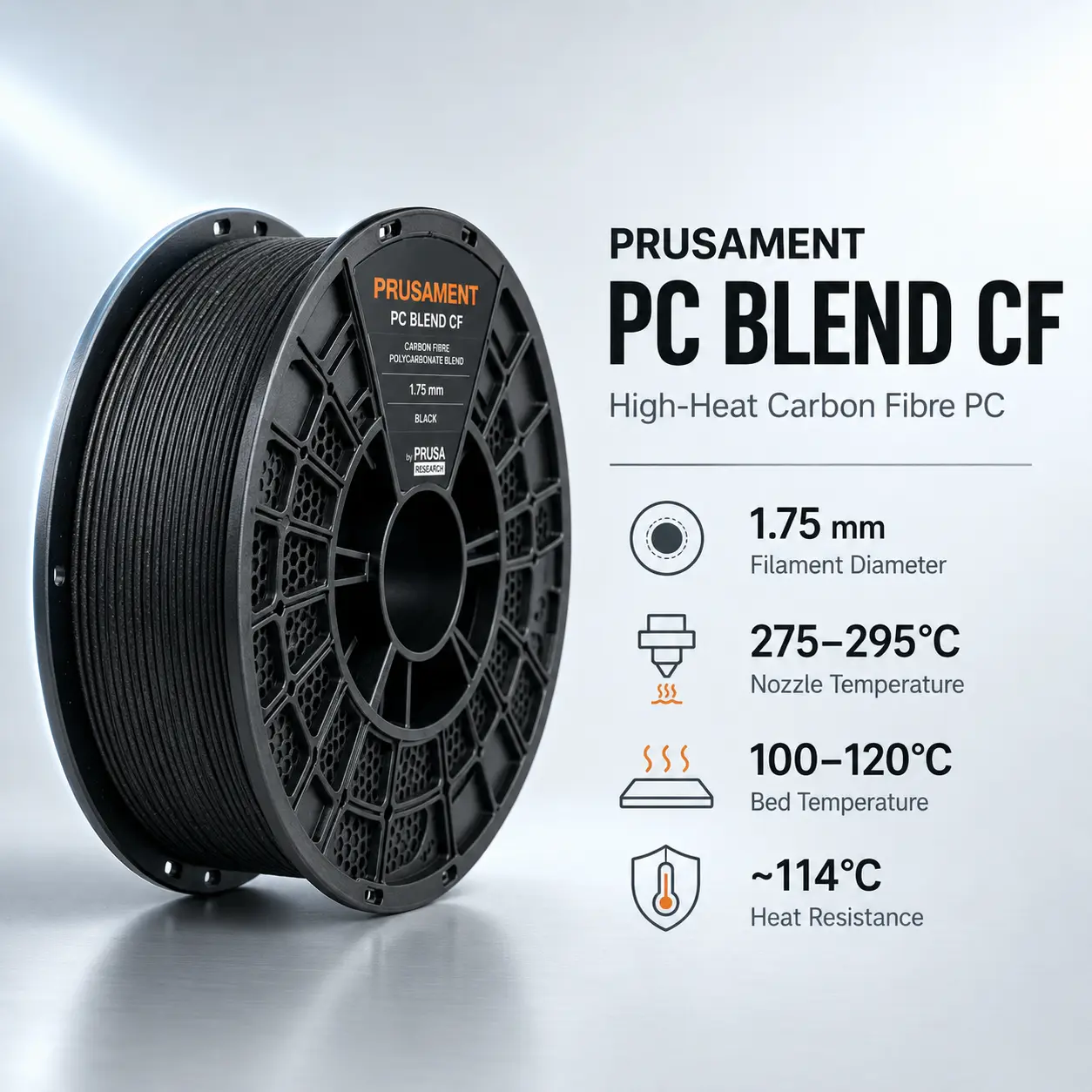
The indexed Prusament PC Blend Carbon Fiber is a carbon-fiber-reinforced PC blend focused on stiffness, dimensional stability, reduced warping, and a matte engineering finish.
Prusament publishes 114°C HDT at 0.45 MPa and 106°C at 1.8 MPa for PC Blend Carbon Fiber. The heat-resistance range is close to PolyMax PC, but the materials behave very differently.
Prefer PolyMax PC when impact toughness, non-abrasive printing, and standard-nozzle compatibility matter. Choose Prusament PC Blend Carbon Fiber when stiffness, low warping, and dimensional stability justify hardened-nozzle use.
This targets searches such as PolyMax PC vs PC-CF and polycarbonate filament vs carbon-fiber polycarbonate.
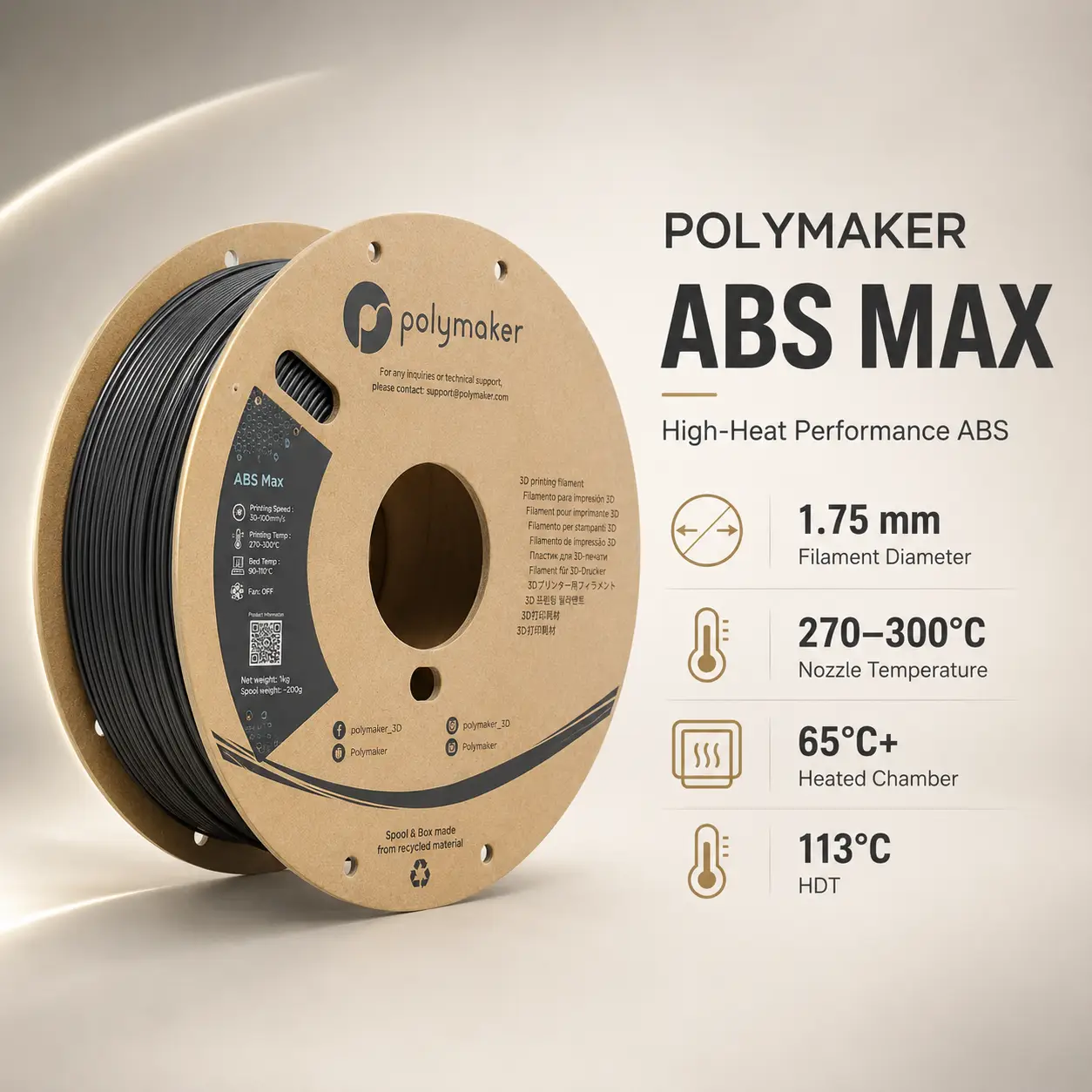
The indexed Polymaker ABS Max targets advanced ABS printing with an actively heated chamber.
ABS Max publishes approximately 118.1°C HDT at 0.45 MPa and 113.1°C at 1.8 MPa, slightly above PolyMax PC under the listed test conditions.
Choose PolyMax PC for tough PC parts where layer adhesion, vibration resistance, and polycarbonate behavior are priorities. Choose ABS Max when high-temperature ABS, creep resistance, and ABS-style processing or post-processing are more attractive.
This comparison also targets PolyMax PC vs ABS, PC filament vs ABS, and best heat-resistant filament for tooling.
Polymaker PC-ABS blends polycarbonate and ABS for toughness, heat resistance, surface finish, and metal-plating compatibility.
Polymaker publishes approximately 39.9 MPa XY tensile strength, 25.8 kJ/m² notched Charpy impact strength, 112°C HDT at 0.45 MPa, 106°C HDT at 1.8 MPa, and 135°C Vicat.
PolyMax PC has higher tensile strength and slightly higher low-load HDT, while PC-ABS has higher published notched impact and better positioning for cosmetic automotive or plated parts.
Choose PolyMax PC for tough PC-focused engineering applications. Choose PC-ABS for automotive interiors, smooth surface finish, plating compatibility, and a PC/ABS property balance.
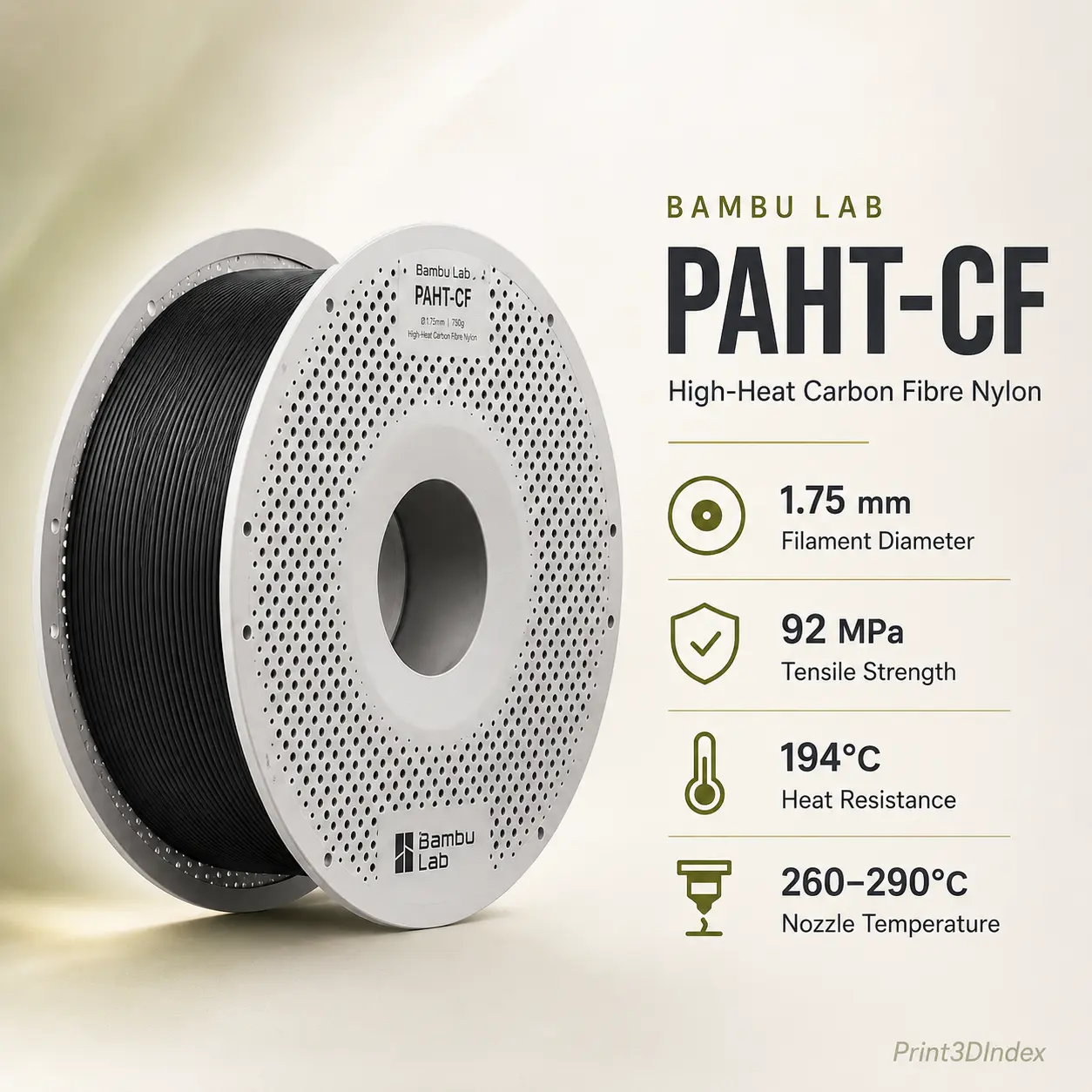
The indexed Polymaker Fiberon PA6-CF20 is a much higher-temperature carbon-fiber nylon.
PA6-CF20 publishes 109.3 MPa dry annealed XY tensile strength and 215°C HDT at 0.45 MPa, far above PolyMax PC in stiffness and thermal capability.
The trade-offs are moisture sensitivity, abrasive wear, higher nozzle temperature, and disciplined drying and annealing.
Choose PolyMax PC for tough non-abrasive engineering parts in the roughly 100°C-class service range. Choose PA6-CF20 when very high stiffness and heat resistance justify carbon-fiber hardware and moisture management.
| Material | Main Strength | HDT | Abrasive | Printing Demand |
|---|---|---|---|---|
| PolyMax PC | Tough non-abrasive PC | 114°C @ 0.45 / 99°C @ 1.8 MPa | No | High |
| PolyLite PC | Stiff translucent PC | 111°C @ 0.45 MPa | No | High |
| Prusament PC Blend Carbon Fiber | Stiff low-warp PC-CF | 114°C @ 0.45 / 106°C @ 1.8 MPa | Yes | Medium-high |
| Polymaker ABS Max | High-heat ABS / creep resistance | 118.1°C @ 0.45 / 113.1°C @ 1.8 MPa | No | High |
| Polymaker PC-ABS | Tough PC/ABS blend | 112°C @ 0.45 / 106°C @ 1.8 MPa | No | High |
| Fiberon PA6-CF20 | Very stiff high-temp PA6-CF | 215°C @ 0.45 / 173°C @ 1.8 MPa | Yes | Very high |
Cross-manufacturer values use different specimens, conditioning, print directions, and post-processing. Use the table for material positioning rather than direct engineering substitution.
Polymaker PolyMax PC is available in Black, White, Grey, Blue, and Red with 0.75 kg and 3 kg spool options. The current US price is from US$38.99. For buyers comparing Polymaker PolyMax PC price per gram, the 0.75 kg spool works out to about US$0.052/g. Approximately €33.35 in Europe, £28.55 in the UK, AED 143.19 in the UAE, C$53.56 in Canada, A$54.39 in Australia and ₹3,730 in India. Actual pricing, availability, tax, shipping, and promotions may vary by region and spool size.
It is a tough engineering polycarbonate filament designed for heat-resistant, impact-resistant functional parts.
Polymaker recommends 250–270°C.
90–105°C.
The current TDS lists 50–200 mm/s.
Yes. Polymaker's current US printing requirements list an enclosed printer as required.
An actively heated chamber is highly recommended, with about 70°C minimum recommended. Large or dense parts may require it.
53.44 ± 0.60 MPa in the XY direction.
HDT is 114°C at 0.45 MPa and 99°C at 1.8 MPa.
No. Standard PolyMax PC does not contain carbon or glass fiber reinforcement.
Dry at 75°C for 6 hours if the filament has absorbed moisture, and use dry storage for best results.
Yes. Polymaker recommends 90°C for 2 hours after printing to release residual stress.
PolyLite PC is stiffer and has higher tensile strength, while PolyMax PC has much higher notched impact toughness.
PolyMax PC is better when impact toughness and non-abrasive printing matter; PC-CF is generally better when maximum stiffness and dimensional stability are priorities.
Current US listings show Black, White, Grey, Blue, and Red.
Polymaker PolyMax PC is available in Black, White, Grey, Blue, and Red, with 0.75 kg and 3 kg spool options. The current US price is from US$38.99. For buyers comparing Polymaker PolyMax PC price per gram, the 0.75 kg spool works out to about US$0.052/g.
Use an enclosed printer with a 270°C-capable all-metal hotend, 105°C-class bed, and preferably active chamber heating. Large dense parts benefit from approximately 70°C or higher chamber temperature.