Impact-Resistant Engineering ABSLow-Warp Functional FilamentHeat-Resistant ABS MaterialDurable Mechanical ABSHigh-Speed ABS FilamentWater-Resistant Engineering ABS
BBambu Lab
Bambu Lab
# Bambu Lab ABS
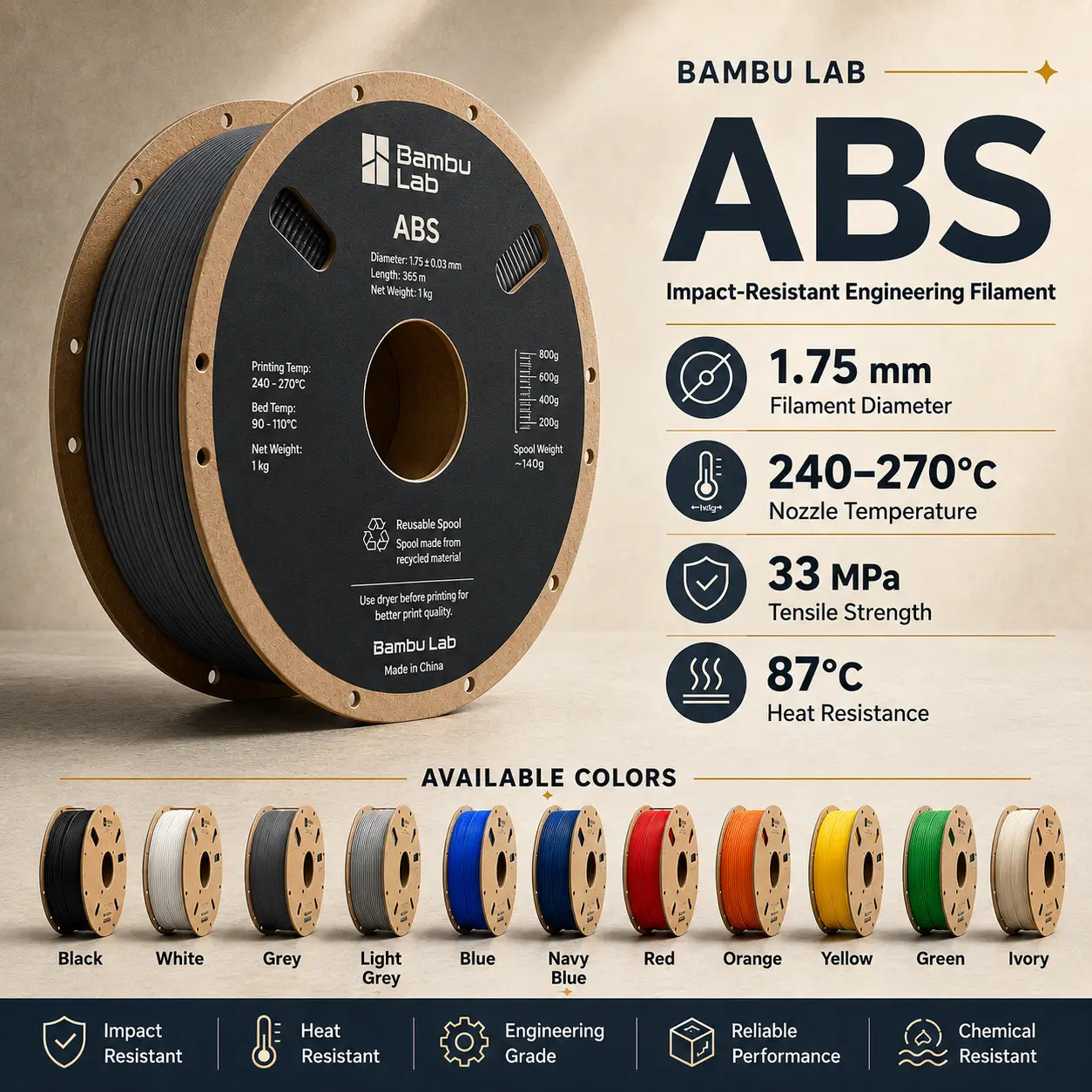
Bambu Lab ABS is a 1.75 mm engineering filament for functional prototypes, housings, fixtures, automotive interior parts, tooling, and other applications that need more heat and impact resistance than standard PLA.
Bambu positions its ABS formulation around toughness, water resistance, good low-temperature impact behavior, and reduced warping compared with conventional ABS. It still behaves like ABS: best results come from an enclosed printer, hot build plate, strong first-layer adhesion, and controlled cooling.
Bambu publishes 33 ± 3 MPa XY tensile strength, 39.3 ± 3.6 kJ/m² XY impact strength, 87°C HDT at 0.45 MPa, and 84°C HDT at 1.8 MPa. Standard Bambu ABS is non-abrasive, so a hardened nozzle is not required solely because of the filament.
ABS also produces unpleasant and potentially harmful fumes during printing. Bambu's ABS/ASA guidance calls for an enclosed printer plus good ventilation, filtration, or exhaust.
For current product information, see the official Bambu Lab ABS page and Bambu Lab ABS/ASA/PC usage guide.
| Specification | Value |
|---|---|
| Material | ABS filament |
| Printing process | FDM / FFF |
| Diameter | 1.75 ± 0.03 mm |
| Net filament weight | 1 kg |
| Formats | Spool / refill |
| Nozzle temperature | 240–270°C |
| Bed temperature | 80–100°C |
| Published print speed | Below 300 mm/s |
| Cooling | 0–80%, geometry-dependent |
| Enclosure | Required / strongly recommended |
| Drying | 80°C for 8 hours when needed |
| Storage | Sealed; below 20% RH recommended |
| Density | Approx. 1.05 g/cm³ |
| Melting temperature | Approx. 200°C |
| Vicat softening temperature | 94°C |
| HDT at 0.45 MPa | 87°C |
| HDT at 1.8 MPa | 84°C |
| XY tensile strength | 33 ± 3 MPa |
| Z tensile strength | 28 ± 2 MPa |
| XY Young's modulus | 2200 ± 190 MPa |
| XY elongation at break | 10.5 ± 1.0% |
| XY flexural strength | 62 ± 4 MPa |
| XY flexural modulus | 1880 ± 110 MPa |
| XY impact strength | 39.3 ± 3.6 kJ/m² |
| Z impact strength | 7.4 ± 1.2 kJ/m² |
| Water absorption | Approx. 0.65% at 25°C / 55% RH |
| Abrasive | No |
Mechanical and thermal figures are manufacturer test values from defined specimen conditions. Finished-part behavior varies with orientation, geometry, infill, layer bonding, annealing, and process settings.
Bambu's ABS guidance recommends:
ABS shrinks as it cools, so large models and high-infill parts are the most likely to lift, split, or warp. Lower print speeds, a warmer bed, stable chamber temperature, and a generous brim can improve difficult parts.
Bambu's technical profile also documents roughly 45–60°C chamber temperature as a useful ABS range. Active chamber heating is not mandatory for every part, but stable chamber temperature becomes more valuable as part size and dimensional requirements increase.
Bambu ABS should be treated as an enclosed-printer material rather than a universal Bambu filament.
The indexed Bambu Lab P2S is a practical ABS platform because it combines an enclosed build chamber with a 300°C hotend and 110°C bed.
The Bambu Lab H2D provides an even more controlled engineering-material workflow with higher hotend capability and active chamber heating.
By contrast, the open-frame Bambu Lab A1 is not the preferred general-purpose ABS platform because it lacks an enclosed chamber.
Standard Bambu ABS is compatible with:
It is not compatible with AMS Lite in Bambu's current product guidance.
RFID stores material information that compatible Bambu systems can read automatically.
Feeding compatibility and drying capability are separate issues, especially for users researching the Bambu Lab AMS 2 Pro filament dryer.
AMS 2 Pro can feed and store Bambu ABS, but its maximum drying temperature is 65°C.
Bambu's current filament guide recommends 80°C for 8 hours for ABS in a forced-air drying oven and marks AMS 2 Pro drying as not recommended for ABS because it cannot reach the preferred drying temperature.
The practical distinction is:
For wet ABS, use Bambu's higher-temperature drying method or a compatible higher-temperature drying system.
ABS should not be treated like ordinary Bambu PLA from an indoor-air standpoint.
Bambu's ABS/ASA safety guidance states that ABS can release harmful gases such as styrene at printing temperatures. Use an enclosed printer in a well-ventilated location or provide effective filtration/exhaust.
Bambu ABS combines 33 ± 3 MPa XY tensile strength, 39.3 ± 3.6 kJ/m² XY impact strength, and 87°C / 84°C HDT at 0.45 / 1.8 MPa. Z-direction strength and impact values are lower, so orientation and layer adhesion matter for functional parts.
Bambu also documents optional annealing around 80–90°C for 6–12 hours. Annealing can change dimensions or cause warping, so validate it before tolerance-critical use.
For buyers comparing Bambu filament cost per gram, the current US Bambu ABS page lists about US$19.99 for the 1 kg product class, with dynamic bulk and promotional pricing that can be lower.
At US$19.99 per 1,000 g:
Bulk-sale pricing can reduce that number, so current checkout pricing is more useful than a fixed historical promotion.
For regional reference, the estimated price is €17.14 in Europe, £14.70 in the United Kingdom, AED 73.40 in the UAE, C$27.63 in Canada, A$28.08 in Australia, and ₹1,911 in India. Actual regional prices may vary because of local pricing, taxes, shipping, promotions, stock,
Users searching for Bambu filament, Bambu Lab filament, Bambu filaments, Bambu PLA, or Bambu Lab PLA should treat ABS as a separate engineering-material category rather than a tougher drop-in version of PLA.
Compared with Bambu Lab PLA, ABS offers:
The phrase “Bambu Labs filament” is a common search variation; the manufacturer name is Bambu Lab.
For simple room-temperature models, PLA is easier. ABS becomes worthwhile when heat, impact, machining, or engineering use is the reason for the print.
A common buyer question is “does Bambu come with filament?”
Package contents depend on the exact printer and bundle. Some Bambu printers may include sample material, but buyers should not assume a printer includes a full 1 kg spool of ABS.
Bambu ABS is sold separately, so plan to order a spool/refill for an ABS project.
| Material | Main Advantage | HDT Context | Printing Difficulty | Outdoor / UV |
|---|---|---|---|---|
| Bambu Lab ABS | Impact + heat + value | 87°C @ 0.45 MPa | Medium | Limited |
| Bambu ASA | UV/weather resistance | About 100°C @ 0.45 MPa | Medium | Excellent |
| Bambu ABS-GF | Higher stiffness / lower warp | About 99°C @ 0.45 MPa | Medium | Limited |
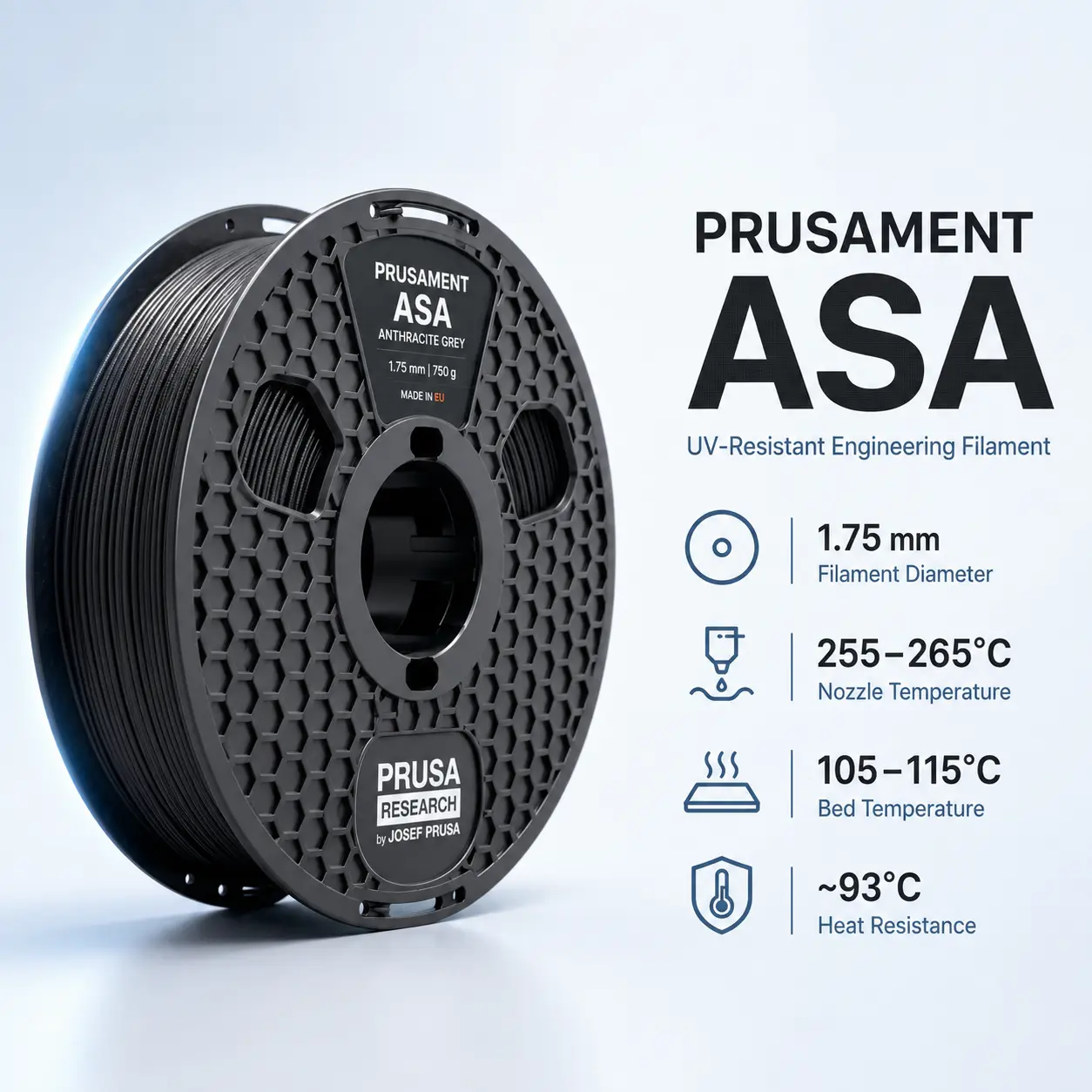
| Prusament ASA | Outdoor engineering | About 93°C @ 0.45 MPa | Medium | Excellent |
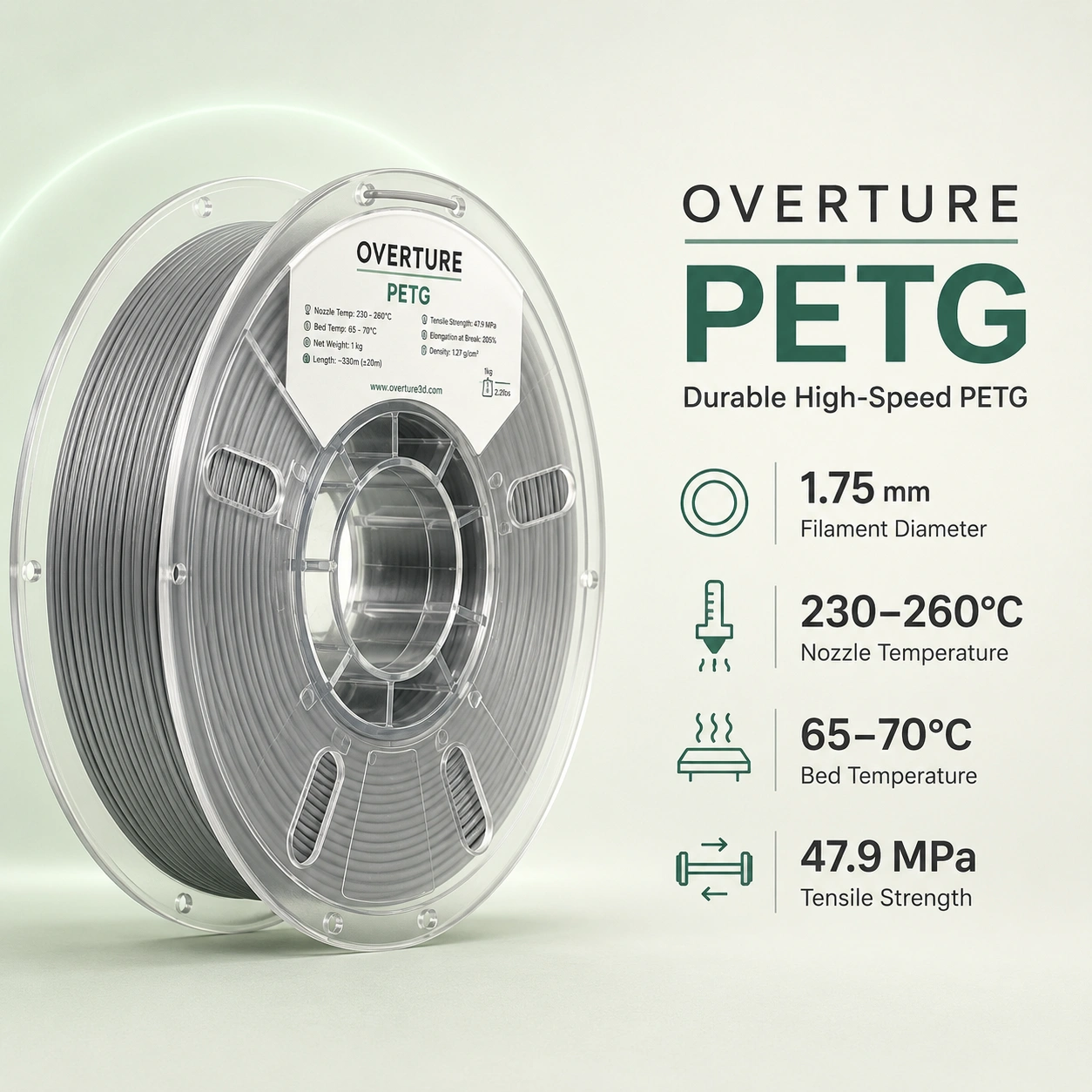
| Prusament PETG | Easy tough functional printing | About 68°C | Easy–medium | General use |
Values come from different manufacturers and test conditions and should be used for material positioning rather than direct engineering-design substitution.
The Bambu ABS vs Bambu ASA comparison is one of the most useful choices for functional Bambu filament.
Bambu ASA uses a similar enclosed high-temperature workflow but adds much better UV and weather resistance. Bambu publishes about 100°C HDT at 0.45 MPa for ASA versus 87°C for ABS.
Choose ABS for durable indoor engineering parts and better value.
Choose ASA for outdoor parts, UV exposure, higher heat resistance, and weather-facing automotive components.
See the official Bambu ASA page.
The Bambu ABS vs ABS-GF comparison is toughness versus stiffness and dimensional stability.
Standard Bambu ABS publishes 39.3 kJ/m² XY impact strength and 87°C HDT.
Bambu ABS-GF raises HDT to about 99°C and flexural modulus to about 2860 MPa, but the glass-fiber reinforcement reduces impact toughness and makes the filament abrasive.
Choose standard ABS when impact resistance, non-abrasive printing, and easier nozzle compatibility matter.
Choose ABS-GF when stiffness, dimensional stability, matte appearance, and higher thermal resistance matter more.
See the official Bambu ABS-GF page.
The indexed Prusament ASA is a strong third-party comparison.
Prusament ASA publishes about 93°C HDT at 0.45 MPa and is designed for UV-stable outdoor applications.
Choose Bambu ABS for indoor fixtures, prototypes, enclosures, and durable general engineering parts.
Choose Prusament ASA when sunlight, outdoor durability, and weather resistance are major requirements.
The indexed Prusament PETG is easier to print and has much lower warping than ABS.
PETG does not normally require an enclosure and offers strong layer adhesion and toughness, but its published heat resistance is around 68°C HDT, below Bambu ABS at 87°C.
Choose PETG when easy printing and low warping matter most.
Choose Bambu ABS when higher heat resistance, impact performance, or traditional ABS post-processing is more important.
It is a 1.75 mm engineering ABS filament for durable, heat-resistant, impact-resistant functional parts.
240–270°C.
80–100°C.
Bambu publishes a material speed below 300 mm/s.
33 ± 3 MPa XY.
87°C HDT at 0.45 MPa and 84°C at 1.8 MPa.
Yes. Bambu's current product guidance uses an enclosed-printer workflow.
No.
It is compatible with AMS, AMS 2 Pro, and AMS HT, but not AMS Lite.
It can feed and store ABS, but its 65°C maximum is below Bambu's 80°C ABS drying recommendation, so AMS 2 Pro drying is not recommended for fully drying ABS.
At US$19.99 per 1 kg, the cost is about US$0.020 per gram before tax, shipping, or bulk discounts.
Package contents vary. Do not assume a printer includes a full 1 kg ABS spool.
ABS offers higher heat and impact resistance, while Bambu Lab PLA is easier to print and does not require an enclosed high-temperature workflow.
ASA is normally the better choice for long-term sunlight and weather exposure.
Drying is recommended when needed; Bambu's current guide uses about 80°C for 8 hours.
Use an enclosed printer with good ventilation, filtration, or exhaust because Bambu warns about harmful gases such as styrene during ABS printing.