Large Format Heated ChamberEngineering Material PlatformHigh Temperature FDMLarge Part ProductionTooling And Fixture ProductionEnclosed Engineering 3D Printing
PPrusa
Prusa
# Prusa CORE One L+
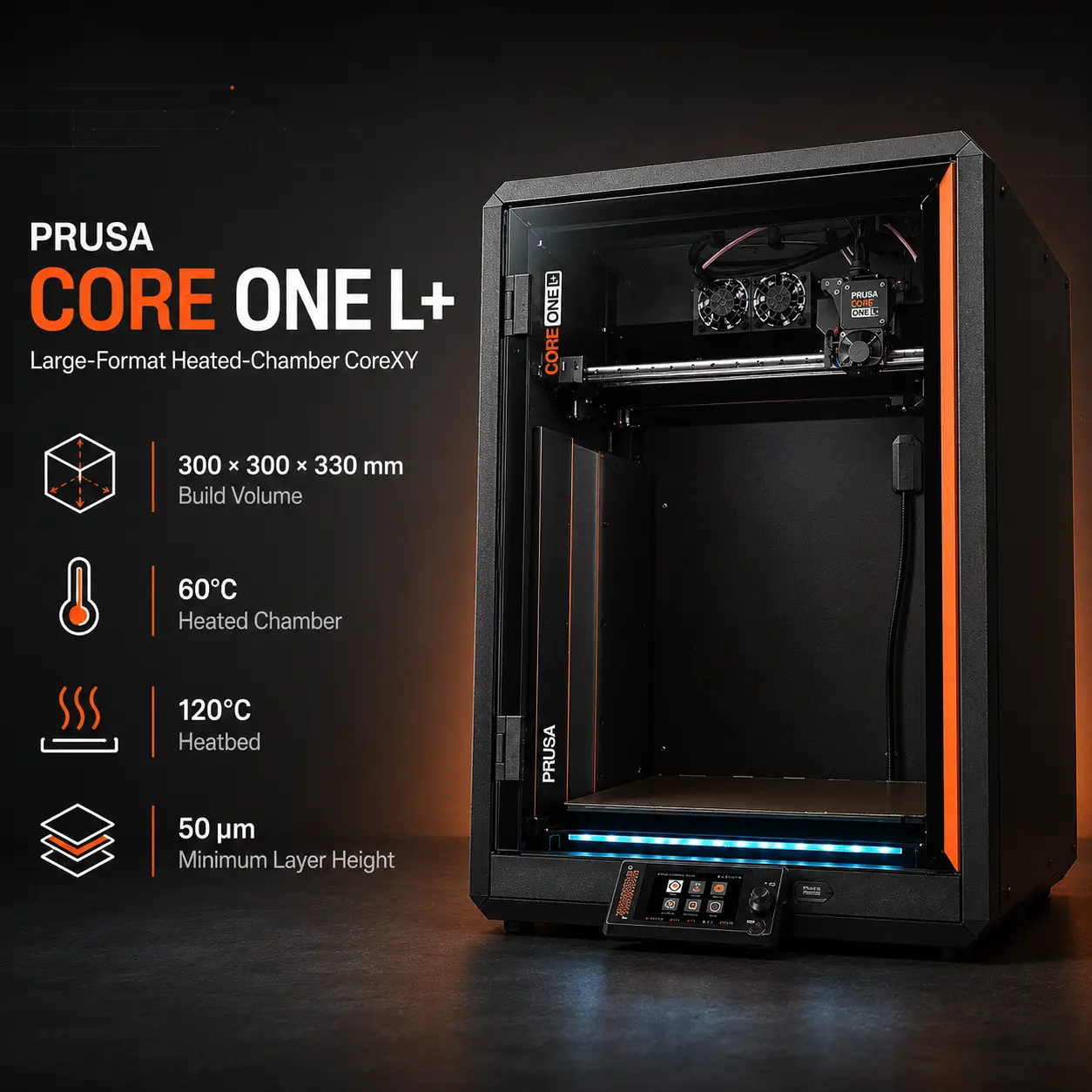
Prusa CORE One L+ is a large-format enclosed CoreXY 3D printer for engineering, tooling, prototyping, education, and production work. It provides a 300 × 300 × 330 mm build volume—about 30 liters—with a 60°C actively heated convection chamber, a large all-aluminum AC heatbed, and Prusa's Nextruder direct-drive extrusion system.
The L+ is the August 2026 refresh of the CORE One L. Its main hardware changes are GT1.5 motion belts and an integrated nozzle wiper. The belts are intended to make repeating surface artifacts finer and less visible, while the wiper removes loose filament from the nozzle before printing.
The standard all-metal hotend reaches 290°C and ships with a 0.4 mm Prusa Brass High-Flow CHT nozzle plus a separate 0.4 mm abrasion-resistant nozzle for filled materials. An optional HT Hotend Upgrade raises the nozzle limit to 400°C for selected high-performance polymers including PEKK-CF, PPS-CF, PPSU, and PPA-CF.
For current pricing, configuration, and availability, see the official Prusa CORE One L+ product page.
| Specification | Value |
|---|---|
| Printing technology | FDM / FFF |
| Motion system | CoreXY |
| Build volume | 300 × 300 × 330 mm |
| Build capacity | Approximately 30 L |
| Filament diameter | 1.75 mm |
| Layer height | 0.05–0.30 mm |
| Standard nozzle | 0.4 mm Prusa Brass High-Flow CHT |
| Additional included nozzle | 0.4 mm abrasion-resistant nozzle |
| Standard maximum nozzle temperature | 290°C |
| Optional HT Hotend maximum | Up to 400°C |
| Maximum heatbed temperature | 120°C |
| Maximum chamber temperature | 60°C |
| Chamber heating | Active convection |
| Extruder | Nextruder direct drive, 10:1 planetary gearing |
| Print surface | Removable dual-sided PEI spring-steel sheet |
| Automatic calibration | Load-cell mesh bed leveling and first-layer calibration |
| Motion compensation | Input Shaper and Phase Stepping |
| Camera | Included 1080p night-vision camera |
| Printer dimensions | 469 × 521 × 635 mm |
| Printer weight | 21.9 kg |
| Connectivity | Ethernet, Wi-Fi, NFC receiver |
| Offline printing | Yes |
| Mains handling | Auto-configures for 110 V / 230 V |
| Published power consumption | 16 W standby; ~630 W preheating; ~90 W average PLA; ~215 W average ASA |
| Software | PrusaSlicer, Prusa Connect, EasyPrint, Prusa App |
The CORE One L+ retains the CORE One L's main build-volume, heatbed, chamber, and extrusion architecture while adding two practical hardware updates.
The refreshed motion system uses GT1.5 belts. Prusa says the finer belt pitch helps make repeating motion artifacts smaller and less noticeable, particularly on broad smooth surfaces.
The new nozzle wiper cleans the nozzle before a print starts. Removing loose filament and small blobs before probing and printing can improve first-layer consistency and reduce contamination on the build surface.
The 300 × 300 × 330 mm workspace gives the CORE One L+ approximately 30 liters of printable volume.
That is useful for:
Compared with the smaller Prusa CORE One+, the L+ is the better fit when larger single-piece parts or denser production batches are central to the workflow.
Prusa uses a large all-aluminum AC heatbed with dual-loop heating. The manufacturer states that the design keeps temperature variation below approximately 2°C across 99% of the surface under its stated conditions.
The printer automatically detects whether it is connected to a 110 V or 230 V mains environment and configures the heatbed accordingly.
A maximum bed temperature of 120°C gives useful headroom for common engineering thermoplastics such as ABS, ASA, PC, and PA when used with the correct sheet, material profile, and chamber settings.
The CORE One L+ uses active convection rather than relying only on passive heat from the bed. Fans beneath the heatbed circulate air across the heated surface and raise the chamber temperature to 60°C.
This is particularly useful for larger parts made from materials that shrink during cooling, including ABS, ASA, PC, PA / Nylon, HIPS, and CPE.
For an indexed material example, Prusament ASA benefits from an enclosed, temperature-stable environment when printing larger parts.
The chamber also uses automatic vent control. Low-temperature materials such as PLA and PETG can be printed with the enclosure closed while the printer manages ventilation, whereas higher-temperature profiles can keep the chamber more thermally isolated.
The CORE One L+ uses Prusa's Nextruder direct-drive extruder with a 10:1 planetary gear system.
The printer ships with two 0.4 mm nozzles:
The included wear-resistant nozzle is important for carbon- and glass-fiber-filled filaments.
For example, Prusament PC Blend Carbon Fiber and Prusament PA11 Carbon Fiber both require abrasion-resistant nozzle hardware.
The stock all-metal hotend reaches 290°C.
Prusa's current supported-material list includes:
With the appropriate filtration workflow, Prusa also lists:
The top-level material list therefore stays focused on materials supported by the standard machine rather than mixing in polymers that require the optional HT Hotend.
The optional Prusa HT Hotend Upgrade raises the nozzle ceiling to 400°C.
Prusa specifically lists high-performance materials including:
The CORE One L+'s 60°C chamber makes it better suited to larger high-temperature parts than a smaller passively heated platform.
A 400°C nozzle does not mean every high-temperature polymer will print successfully without further process control. Material drying, chamber temperature, build surface, nozzle material, adhesion strategy, and part geometry still matter.
For a broader overview of composite-capable machines, see Best 3D Printers for Carbon-Fiber Materials in 2026.
The printer is factory-calibrated and uses several systems to reduce manual setup.
The goal is a workflow that can move from file preparation to printing with less manual intervention than older bed-leveling and Z-offset systems.
A 1080p camera with night vision is included with the CORE One L+.
It can be installed for remote monitoring and timelapse capture through Prusa's connected workflow, or left out for environments where no camera is desired.
This is useful in production areas, shared workshops, educational labs, and long-duration engineering jobs.
The CORE One L+ supports:
Internet access is not required to operate the printer, and the Wi-Fi module can be physically removed for stricter offline environments.
Prusa also offers a separate Critical Infrastructure Edition for organizations requiring additional hardware-level restrictions.
The primary slicing application is PrusaSlicer.
Prusa also provides:
The system is not restricted to proprietary filament. Standard 1.75 mm third-party materials can be used with suitable profiles.
The Prusa CORE One+ is the smaller machine in the same family.
The CORE One L+ is the stronger fit when the buyer needs:
The CORE One+ remains easier to place in a smaller workspace when most parts fit its smaller build envelope.
The CORE One L+ competes with other enclosed engineering-focused desktop systems rather than entry-level open-frame printers.
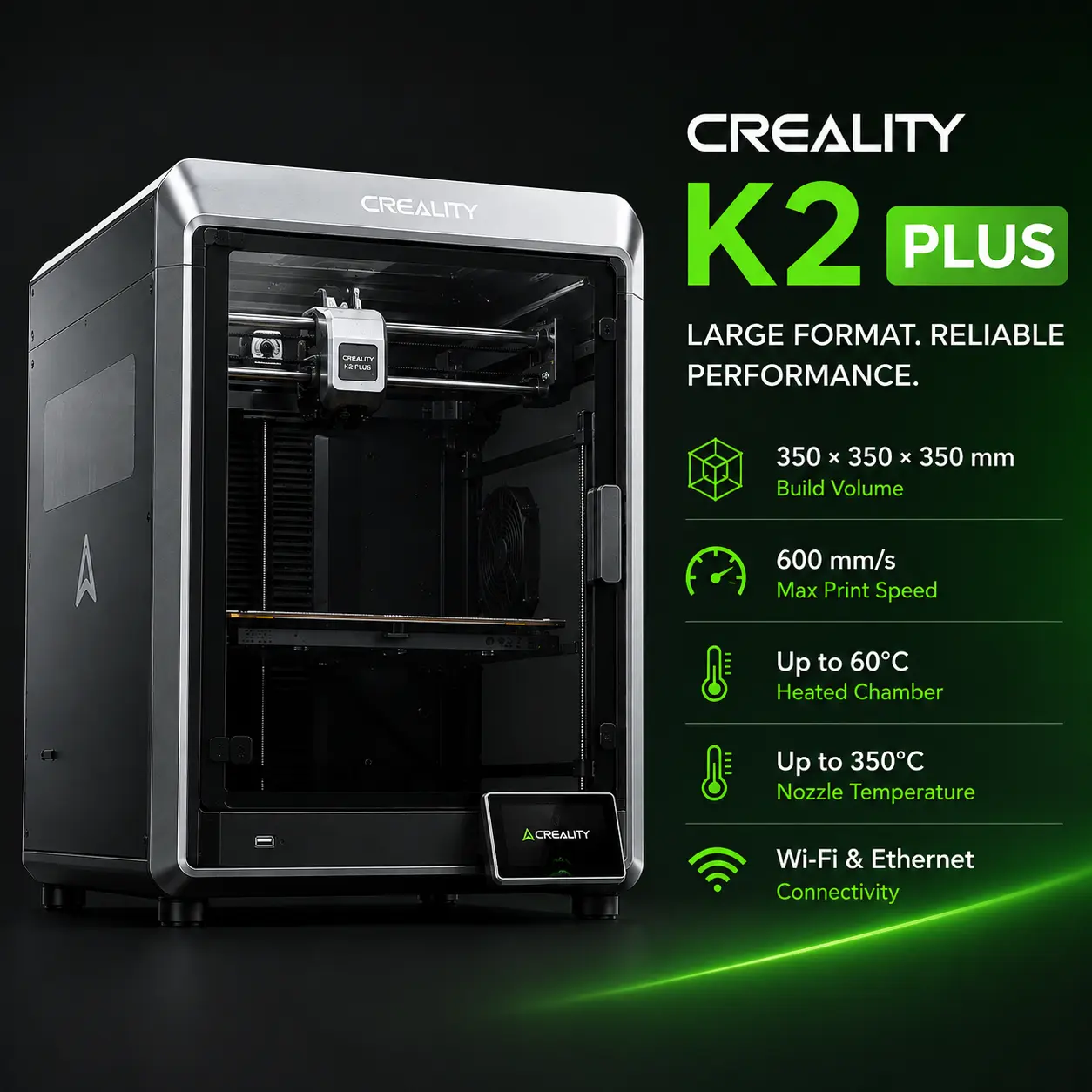
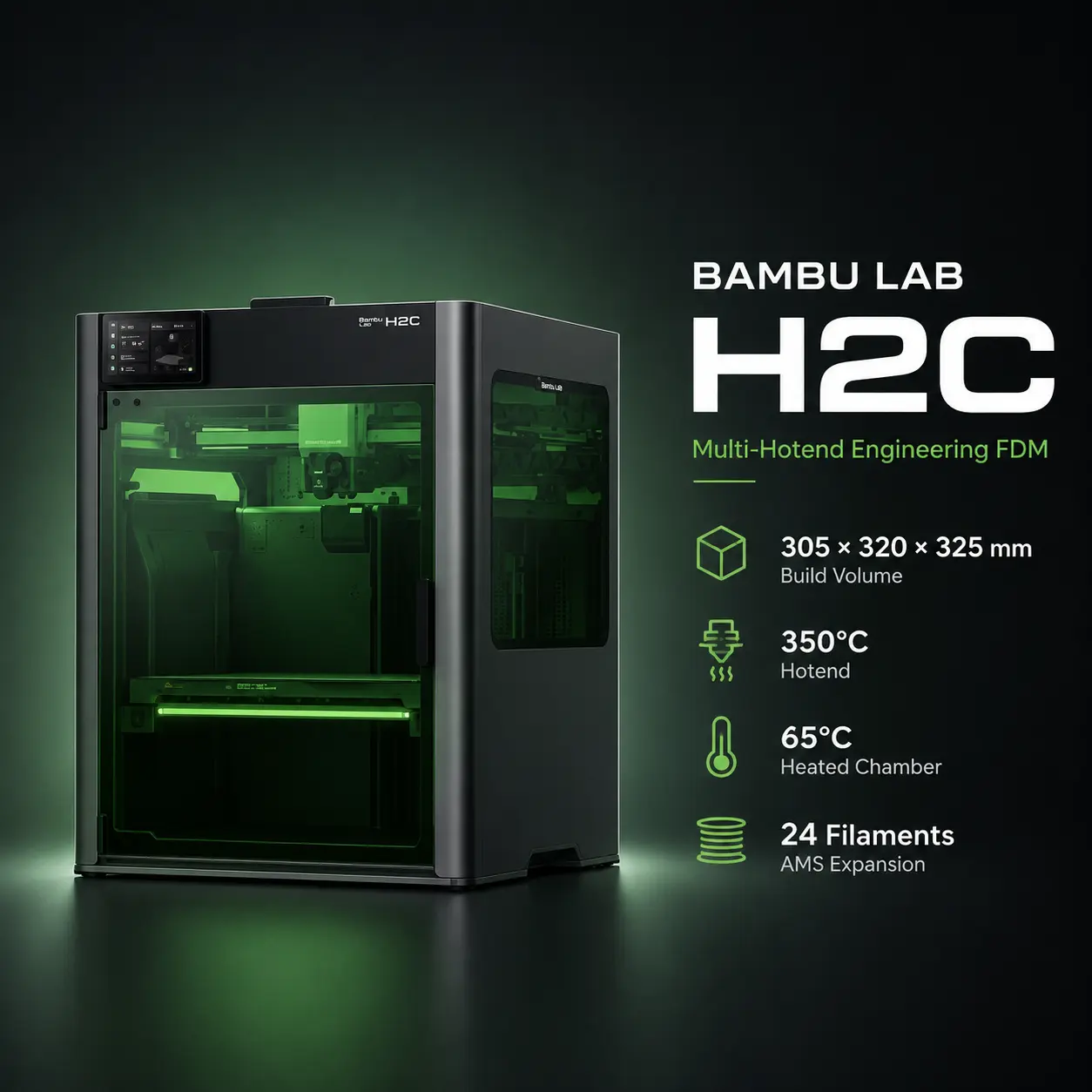
The Creality K2 Plus offers a larger build envelope and active chamber heating, while the Bambu Lab H2D adds a dual-nozzle workflow and broader automation.
The CORE One L+ differentiates itself through:
The current Prusa US listing shows the CORE One L+ at US$1,850. Based on current exchange rates, the estimated equivalent prices are approximately €1,600 in the Eurozone, £1,368 in the UK, C$2,568 in Canada, A$2,621 in Australia, AED 6,798 in the UAE, and ₹176,672 in India.
These are estimated currency conversions only, not confirmed regional retail prices. Actual prices may differ because of VAT, duties, local taxes, shipping, exchange-rate changes, and distributor pricing.
Prusa publishes:
These figures are more useful than a single generic wattage because chamber heating, bed heating, and print temperature change consumption during a job.
Recommended use: Choose the Prusa CORE One L+ when you need a large enclosed CoreXY printer with a controlled 60°C chamber, strong offline capability, reliable automatic calibration, and a practical path from everyday engineering polymers to selected 400°C materials through the optional HT Hotend.
300 × 300 × 330 mm, equivalent to approximately 30 liters.
The L+ adds GT1.5 motion belts and an integrated nozzle wiper while retaining the main CORE One L platform.
Yes. Active convection heats the chamber up to 60°C.
120°C.
290°C.
Yes, with the optional Prusa HT Hotend Upgrade.
Prusa lists materials including PEKK-CF, PPS-CF, PPSU, PPA, and PPA-CF.
A 0.4 mm Prusa Brass High-Flow CHT nozzle is installed and a separate 0.4 mm abrasion-resistant nozzle is included.
Yes, when the material's thermal requirements fit the printer configuration and an abrasion-resistant nozzle is used.
Yes. The printer uses a load-cell system for automatic mesh bed leveling and first-layer setup.
Yes. A detachable 1080p night-vision camera is included.
Yes. It supports USB and local-network printing without mandatory cloud connectivity, and the Wi-Fi module can be physically removed.
Prusa does not currently publish one universal maximum printing-speed figure for the CORE One L+. It publishes travel speeds up to 500 mm/s, which should not be entered as print speed.
The current Prusa USA listing shows the CORE One L+ at US$1,850. Based on current exchange rates, the estimated equivalent prices are approximately €1,600 in the Eurozone, £1,368 in the UK, C$2,568 in Canada, A$2,621 in Australia, AED 6,798 in the UAE, and ₹176,672 in India.
Yes. Prusa began shipping the refreshed model on August 14, 2026 and currently accepts orders.