All-in-One Professional ScanningStandalone 3D ScanningWireless Industrial ScanningDeep-Hole Laser ScanningLarge-Range 3D ScanningHybrid Laser NIR ScanningHigh-Speed Reverse EngineeringFull-Color Industrial Capture
CCreality
Creality
# Creality Sermoon P1
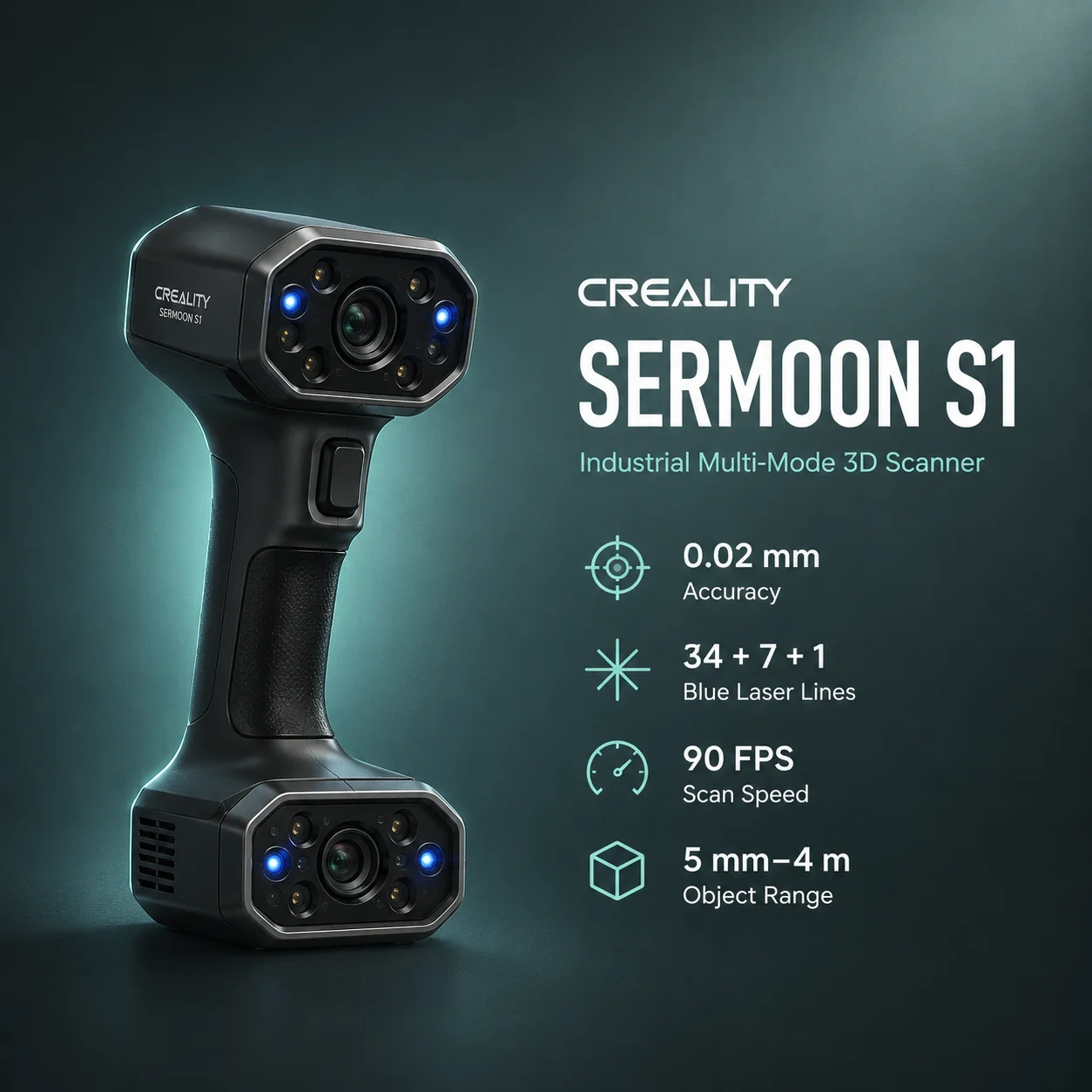
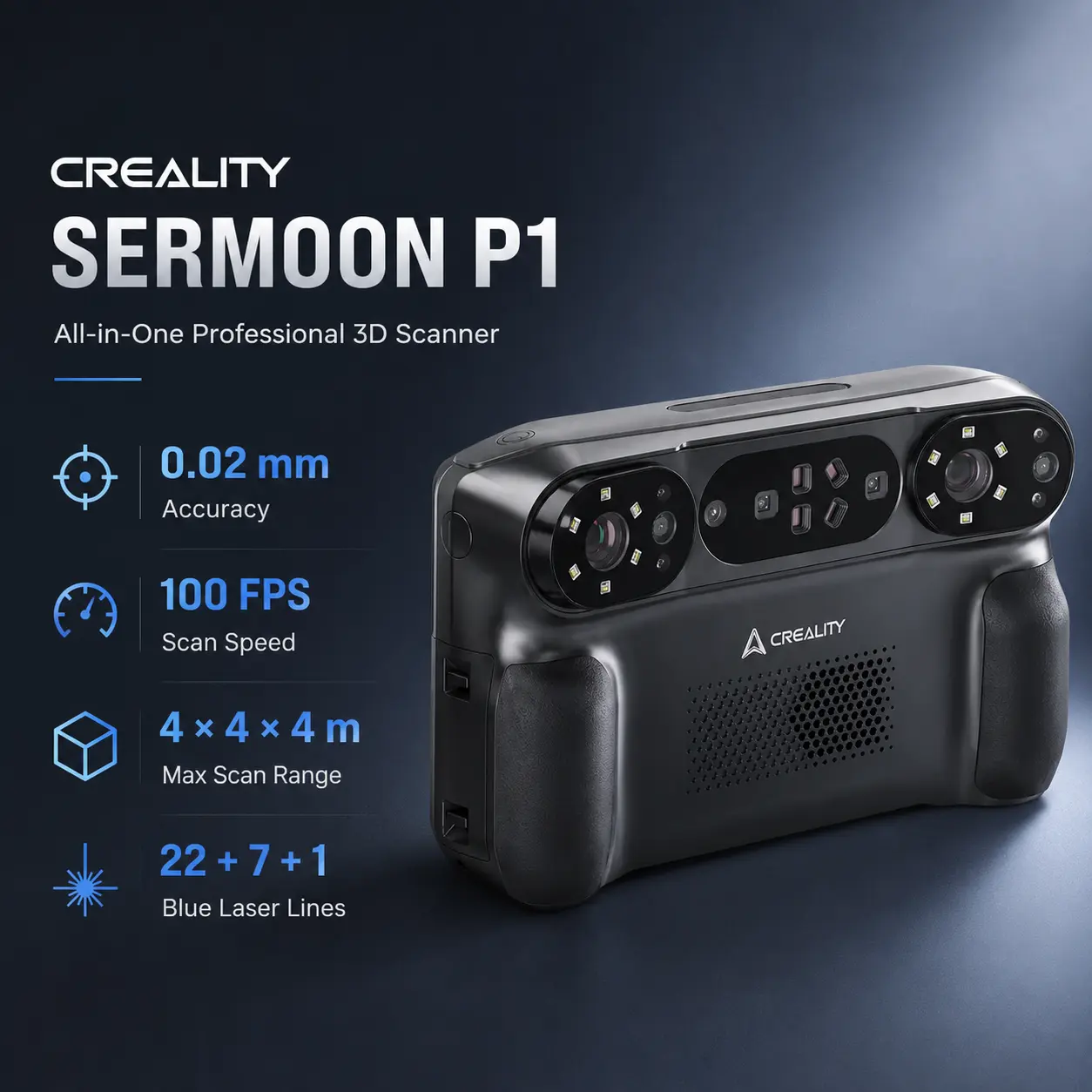
The Creality Sermoon P1 is an all-in-one professional 3D scanner built for reverse engineering, automotive work, dimensional inspection, product development, manufacturing, and field capture. It combines 22 crossed blue laser lines, 7 parallel blue laser lines, a single blue laser line, and dual NIR structured light in one handheld system.
Its biggest distinction is workflow independence. The P1 can scan and process data directly on the device using a Qualcomm-based computing platform with 24 GB LPDDR5X RAM, 256 GB UFS 4.0 storage, a 6-inch HD touchscreen, Wi-Fi 7, and two swappable 3300 mAh batteries. It can also work wirelessly or through a wired PC connection when a larger workstation is preferred.
Creality specifies up to 0.02 mm accuracy for blue-laser scanning and 0.02 mm + 0.06 mm/m volumetric accuracy in laser modes. NIR structured-light scanning is rated at up to 0.075 mm accuracy and is intended for larger objects, body scanning, and marker-free geometry or texture tracking.
The headline throughput figures need context. In PC-connected operation, the 22-cross-line laser mode captures up to 1.74 million points/s, while long-range NIR reaches up to 6.881 million points/s. Laser scanning reaches up to 100 FPS on a wired PC, compared with up to 60 FPS in standalone operation.
For current specifications and pricing, see the official Creality Sermoon P1 product page and the official Sermoon P1 user manual.
Best for reverse engineering, automotive parts, product development, inspection, molds, deep holes, large objects, body scanning, field capture, and full-color 3D scanning.
| Specification | Value |
|---|---|
| Scanner type | Handheld / standalone |
| Scanning technology | Blue laser + dual NIR structured light |
| Blue laser system | 22 crossed + 7 parallel + 1 single line |
| Blue-laser accuracy | Up to 0.02 mm |
| NIR accuracy | Up to 0.075 mm |
| Laser volumetric accuracy | 0.02 mm + 0.06 mm/m |
| NIR volumetric accuracy | 0.075 mm + 0.1 mm/m |
| Laser 3D resolution | 0.05–2 mm |
| NIR 3D resolution | 0.1–2 mm |
| Laser speed, standalone | Up to 60 FPS |
| Laser speed, PC connected | Up to 100 FPS |
| NIR speed, standalone | Up to 15 FPS in detailed specification table |
| NIR speed, PC connected | Up to 30 FPS |
| 22-line laser rate, standalone | Up to 1.044M points/s |
| 22-line laser rate, PC | Up to 1.74M points/s |
| Long-range NIR rate, standalone | Up to 3.44M points/s |
| Long-range NIR rate, PC | Up to 6.881M points/s |
| Minimum blue-laser scan size | 5 × 5 × 5 mm |
| Advertised maximum scan size | Up to 4000 × 4000 × 4000 mm |
| Blue-laser capture area | Up to 380 × 365 mm |
| NIR capture area | Up to 1450 × 1020 mm |
| Working distance | 160–1200 mm depending on mode |
| Color capture | Global-shutter RGB camera |
| Fill lights | 12 dual-color LEDs |
| Laser safety | Class II blue laser |
| NIR safety | Class I |
| Connectivity | Wi-Fi 7, USB 3.0 Type-C |
| Display | 6-inch HD touchscreen |
| Memory | 24 GB LPDDR5X |
| Storage | 256 GB UFS 4.0 |
| Battery | 2 × 3300 mAh, swappable |
| Charging | 65 W USB-C PD 3.0 |
| Weight | 830 g |
| Dimensions | 209 × 129 × 53 mm |
| Operating temperature | -10°C to 40°C |
| Operating humidity | 10–90% RH |
Sermoon P1 combines four capture strategies in one device.
The 22-line mode is the fast laser workflow for larger mechanical parts and broad surfaces.
Creality rates it for:
This mode is particularly relevant to automotive panels, housings, molds, castings, and larger engineering parts.
The 7-line mode concentrates capture on fine geometry.
It is suited to:
Creality specifies a working range of approximately 160–400 mm for this mode.
The single-line mode is designed for deep holes, narrow gaps, recesses, and difficult internal features.
Creality currently demonstrates a depth-to-diameter capability of up to approximately 6:1 under its test conditions.
This mode is useful when the rest of the part can be captured quickly with crossed lasers but individual bores or slots need a more focused line.
NIR structured light extends the scanner toward medium-to-large objects, people, and broader marker-free workflows.
Long-range NIR reaches a single capture area of up to 1450 × 1020 mm at 1200 mm, according to Creality's detailed specification table.
Creality specifies up to 0.02 mm accuracy for the blue-laser modes.
That figure represents the scanner's best-case point-level accuracy under specified conditions. For larger parts, volumetric accuracy is the more useful measurement because it accounts for accumulated error over distance.
Laser volumetric accuracy is specified as:
0.02 mm + 0.06 mm/m
NIR volumetric accuracy is:
0.075 mm + 0.1 mm/m
This makes blue laser the preferred mode for tighter reverse-engineering and inspection work, while NIR prioritizes broader capture and convenience.
For users whose work is centered on formal metrology rather than flexible all-in-one scanning, the comparison with dedicated target- or tracker-based systems becomes important.
A major P1 advantage is that scanning does not have to begin at a workstation.
The scanner integrates:
This reduces the equipment needed for vehicle work, factory-floor inspection, field documentation, and on-site reverse engineering.
Standalone mode is not simply a wireless display. The onboard processor performs scanning and model-processing tasks directly on the device.
For maximum blue-laser frame rate and point throughput, a connected workstation remains the faster option.
The P1 supports three main workflows.
Best for:
Laser scanning reaches up to 60 FPS in standalone mode.
Wi-Fi 7 allows the scanner to stream scan data without a tethering cable.
This can be useful around vehicles, large parts, and workshop assemblies where cable management becomes inconvenient.
USB 3.0 Type-C provides the highest-performance PC workflow.
Creality specifies blue-laser operation up to 100 FPS in PC-connected mode.
Creality advertises an unusually broad overall size range for Sermoon P1.
Blue-laser scanning starts at approximately:
5 × 5 × 5 mm
while the overall system is promoted for scan sizes up to:
4000 × 4000 × 4000 mm
The maximum single-frame area depends heavily on mode and distance.
Examples from Creality's detailed specification table include:
A large advertised scan-size envelope does not mean every mode covers the same range. Small mechanical parts are best matched to laser capture, while large subjects are better suited to NIR or a hybrid workflow.
Working distance is mode-dependent rather than fixed:
The practical overall range is therefore 160–1200 mm, depending on the selected mode.
Creality promotes blue-laser capture of many black and metallic objects without scanning spray. It rates single-line and 22-cross-line modes for up to 100,000 lux and the 7-line mode for up to 50,000 lux.
Surface finish, angle, reflections, and geometry still affect results, so no-spray capability should not be treated as universal.
A global-shutter RGB camera and auxiliary lighting support full-color texture capture.
The lighting system uses 12 dual-color LEDs:
A Qualcomm ISP handles color mapping.
This gives the P1 broader use beyond pure metrology, including digital archiving, product visualization, art capture, and body scanning.
Sermoon P1 includes two replaceable 3300 mAh batteries and supports 65 W USB-C PD 3.0 charging. Creality states that a battery can reach about 80% charge in 50 minutes under specified conditions.
Combined with onboard processing, storage, and Wi-Fi 7, this makes the P1 more self-contained than scanners that require a permanently tethered workstation.
The P1 works with CrealityScan for connected scanning and processing.
Creality also highlights downstream use with professional reverse-engineering and design applications such as:
Supported model formats include:
Exported meshes and point-cloud data can then move into CAD, inspection, or manufacturing workflows depending on the software stack.
| Scanner | Core Technology | Accuracy / Volumetric Accuracy | Workflow | Object Focus | Key Difference |
|---|---|---|---|---|---|
| Creality Sermoon P1 | 22+7+1 blue laser + dual NIR | Up to 0.02 mm; 0.02 + 0.06 mm/m laser | Standalone, Wi-Fi 7, wired PC | Very small to large objects | On-device processing and full-color hybrid scanning |
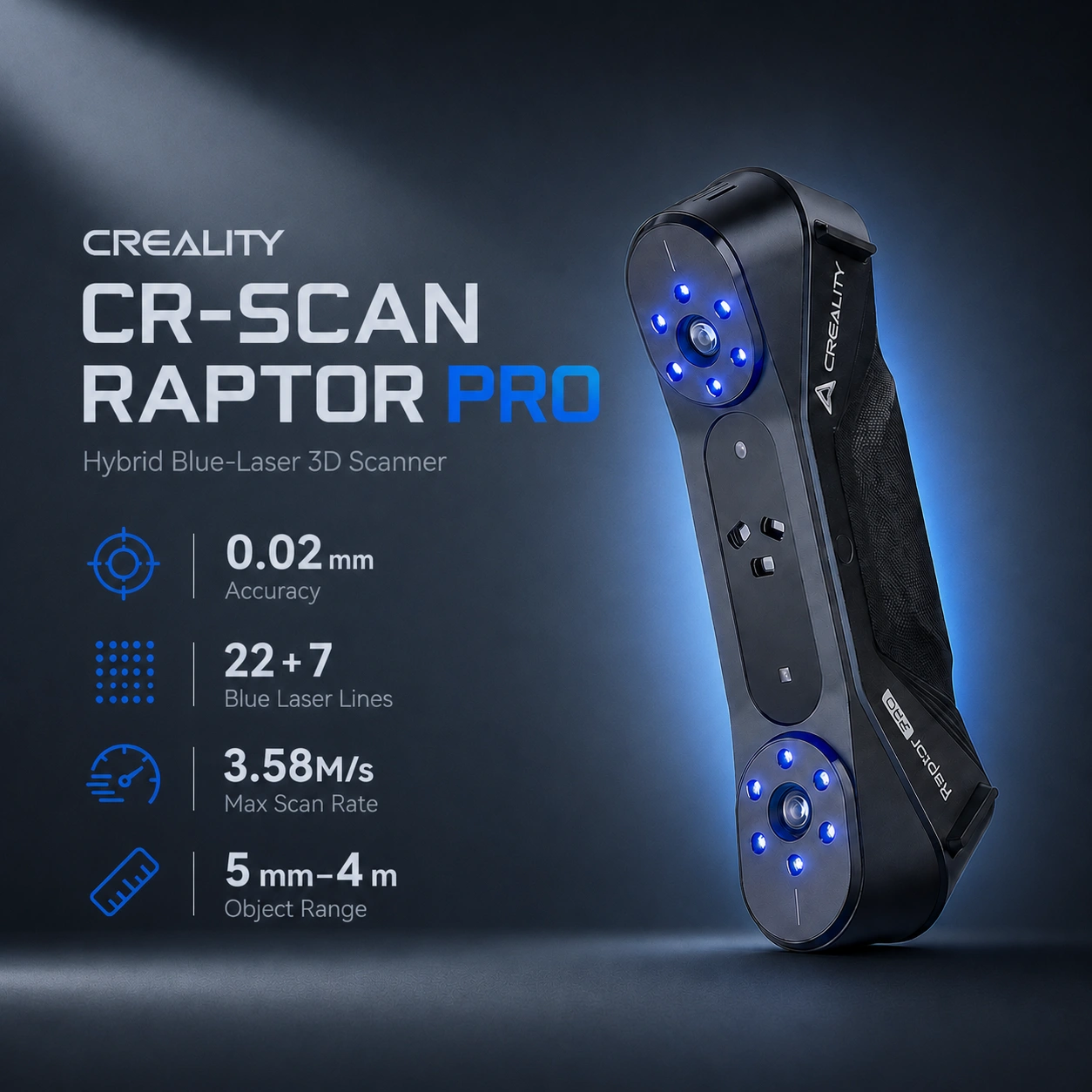
| Creality CR-Scan Raptor Pro | 22 crossed + 7 parallel blue laser + NIR | Up to 0.02 mm; 0.02 + 0.08 mm/m laser | PC-centered handheld workflow | Small to large objects | Lower-cost hybrid laser/NIR alternative |
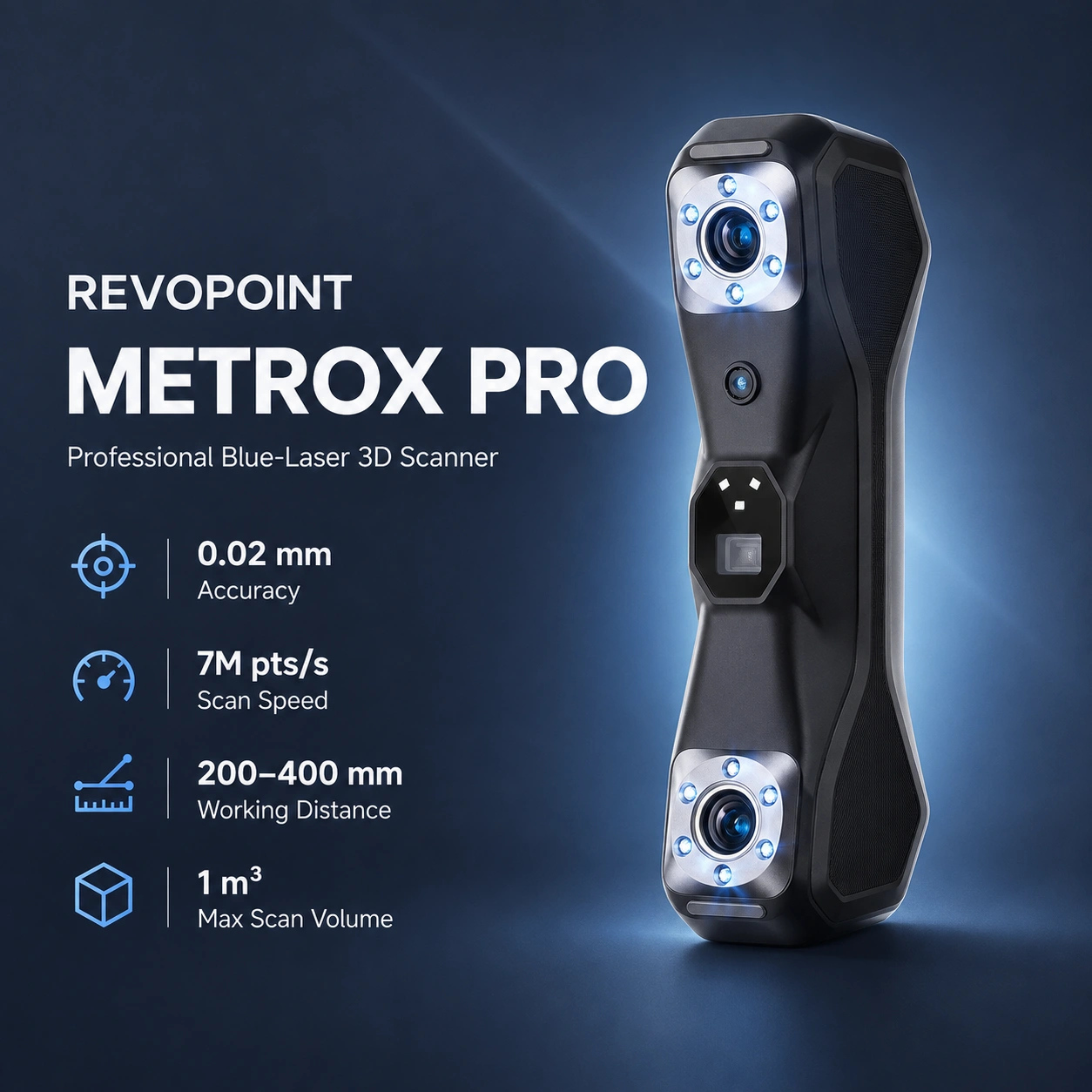
| Revopoint MetroX Pro | 30 crossed + 15 parallel blue lasers + full-field blue structured light | Up to 0.02 mm; 0.02 + 0.04 mm × L | PC-connected handheld/desktop | Small to medium objects | Strong volumetric accuracy and high laser density |
| Revopoint Trackit SR | Optical tracking + 30 crossed + 17 parallel + single laser | 0.025 + 0.04 mm × L volumetric | Wireless tracked scanning | Small to large objects | Marker-free optical tracking |
The table highlights why raw accuracy figures are not enough to choose a scanner. Sermoon P1's main advantage is the combination of professional laser modes, NIR, color capture, batteries, Wi-Fi 7, and onboard processing. MetroX Pro prioritizes small-to-medium object metrology, while Trackit SR is differentiated by tracker-based marker-free scanning.
The Sermoon P1 vs CR-Scan Raptor Pro comparison is the most direct choice within Creality's professional scanner range.
Both combine blue laser and NIR and reach up to 0.02 mm laser accuracy. Raptor Pro also uses 22 crossed and 7 parallel blue laser lines.
Choose Sermoon P1 for standalone processing, built-in display/storage, swappable batteries, Wi-Fi 7, and single-line deep-hole scanning. Choose the Creality CR-Scan Raptor Pro when a PC-centered workflow and lower system cost matter more.
P1's published laser volumetric accuracy is 0.02 mm + 0.06 mm/m, compared with 0.02 mm + 0.08 mm/m for Raptor Pro.
The Sermoon P1 vs Revopoint MetroX Pro comparison is mainly about workflow and object size. Both publish up to 0.02 mm accuracy.
The Revopoint MetroX Pro targets small-to-medium objects with 0.02 mm + 0.04 mm × L volumetric accuracy, 30 crossed lasers, 15 parallel lasers, and full-field blue structured light.
Sermoon P1 is better for standalone operation, NIR large-object/body scanning, color capture, and Wi-Fi 7. MetroX Pro is stronger when tighter published volumetric accuracy and dense laser capture on smaller engineering parts are the priority.
The Sermoon P1 vs Revopoint Trackit SR comparison separates all-in-one scanning from tracker-based scanning.
The Revopoint Trackit SR uses an external optical tracker for marker-free, high-accuracy scanning of low-feature parts.
Trackit SR is stronger when tracker-based wireless inspection is the priority. Sermoon P1 is more self-contained, combining onboard processing, NIR, full-color capture, multiple laser patterns, batteries, and three operating modes in one device.
The Sermoon P1 vs EINSTAR 2 comparison is useful for buyers balancing professional reverse engineering against general-purpose wireless scanning.
The SHINING 3D EINSTAR 2 combines laser and infrared workflows and is designed to cover subjects from small details to large scenes.
EINSTAR 2 is a strong fit when flexible wireless scanning, general object capture, and a lower entry point are more important than standalone processing.
Sermoon P1 is the stronger choice when the workflow benefits from:
The best Creality Sermoon P1 alternative depends on the work.
For additional reverse-engineering guidance, see Best 3D Scanners for Reverse Engineering in 2026 and 3D Scanner Accuracy vs Resolution.
Creality currently lists the Sermoon P1 from US$3,299, approximately €2,852 · £2,439 · C$4,578 · A$4,660 · AED 12,116 · ₹314,891.
The scanner is available through Creality and regional sales channels. Final pricing varies by region, taxes, import duties, shipping, reseller pricing, and promotions.
Recommended use: Choose the Creality Sermoon P1 when you need one portable scanner to cover high-accuracy blue-laser reverse engineering, NIR large-object capture, full-color scanning, deep-hole inspection, and field work without carrying a dedicated computer for every job.
It combines 22 crossed blue laser lines, 7 parallel blue laser lines, a single blue laser line, and dual NIR structured light.
Creality specifies up to 0.02 mm.
0.02 mm + 0.06 mm/m.
Up to 0.075 mm.
Blue-laser scanning reaches up to 60 FPS standalone and 100 FPS with a PC. NIR reaches up to 30 FPS with a PC.
No. That maximum belongs to PC-connected NIR scanning. The 22-cross-line blue-laser mode reaches up to 1.74 million points/s on a connected PC.
Yes. It supports scanning, processing, mesh editing, merging, preview, and export directly on the device.
Yes. Wi-Fi 7 is built in.
Yes. A dedicated single blue laser line is designed for holes, narrow gaps, and recessed geometry.
Creality states that the laser modes can scan many black and metallic objects without spray under supported conditions.
Yes. It uses a global-shutter RGB camera and auxiliary white lighting for full-color texture capture.
It varies by scanning mode, from roughly 160 mm to 1200 mm.
Creality lists up to 1450 × 1020 mm for long-range NIR at 1200 mm.
CrealityScan supports the connected workflow, while e