Standalone Structured LightBrowser Based 3D ScanningFull Color Object CaptureAutofocus Structured LightOnboard Scan ProcessingCross Platform ScanningTurntable Ready ScanningEdge Computing Scanner
MMatter and Form
Matter and Form
# Matter and Form THREE
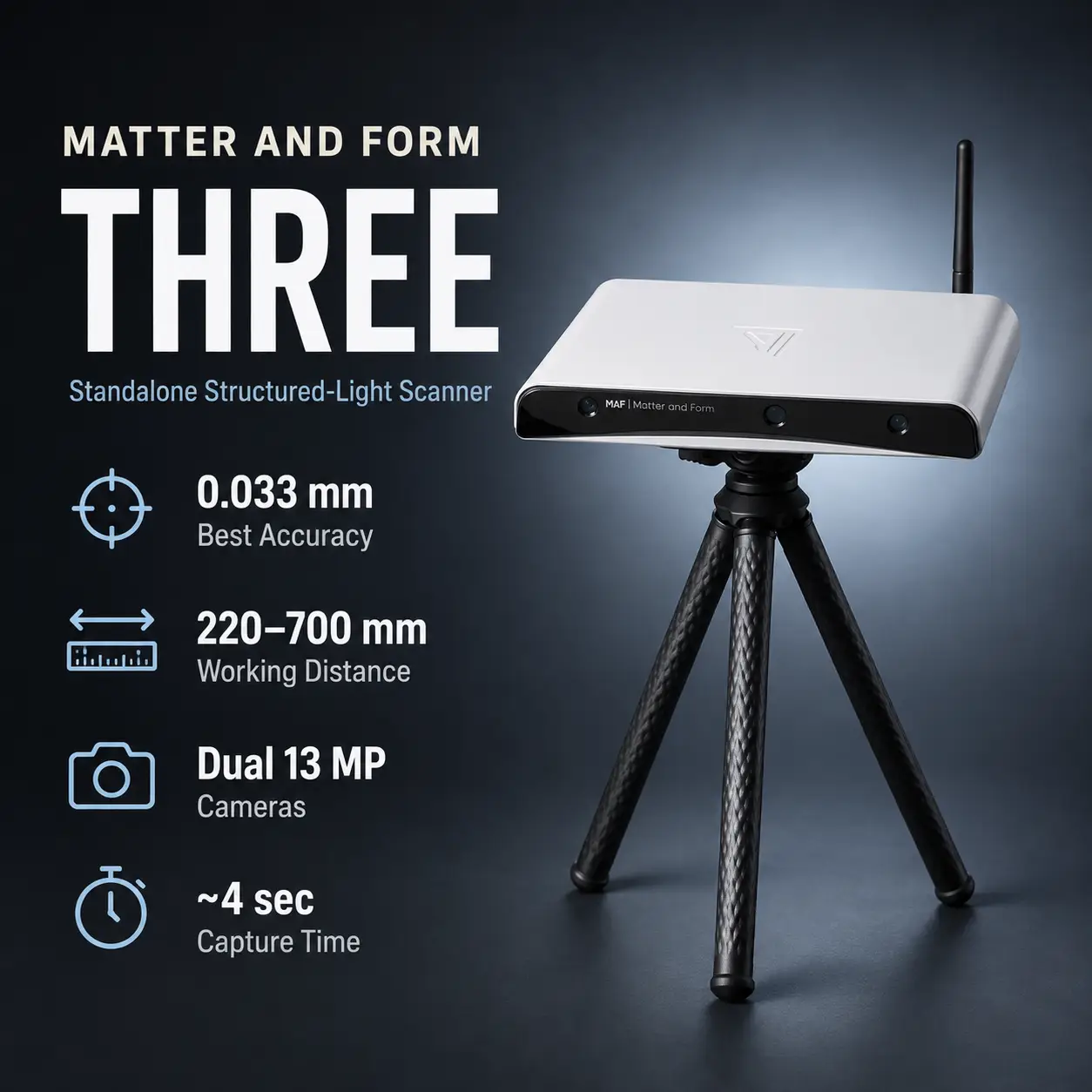
The Matter and Form THREE is a standalone structured-light 3D scanner designed for reverse engineering, 3D printing, product development, education, digital archiving, and full-color object capture. Instead of sending raw scan data to a dedicated workstation for processing, THREE includes its own processor, graphics hardware, memory, storage, and web server.
That architecture makes the workflow unusually platform-independent. The scanner can be controlled from a modern browser on Windows, macOS, Linux, ChromeOS, iPad, Android tablets, and other compatible devices, while the actual scan processing remains on THREE itself. No mandatory cloud service or annual scanning-software subscription is required for the core workflow.
THREE uses stereo structured light with focusable 13 MP Sony cameras and a DLP MEMS projector. At a 220 mm scanner-to-object distance, Matter and Form publishes 33 µm Z accuracy and 37 µm resolution. At longer distances, the capture area becomes larger while accuracy and resolution decrease, making scanner placement an important part of the workflow.
Matter and Form's ChromaSpec color system uses visible-spectrum information for geometry and texture capture. The scanner also includes automatic feature-based alignment, point-pick alignment, automated turntable scanning, measurement and comparison tools, API access, and edge-computing capabilities.
For current specifications and regional pricing, see the official Matter and Form THREE product page.
Best for reverse engineering, 3D printing, product development, mechanical parts, education, full-color capture, heritage objects, turntable scanning, prototypes, and browser-based workflows.
| Specification | Value |
|---|---|
| Scanner type | Standalone structured-light scanner |
| Technology | Stereo structured light with focusable cameras |
| Best published Z accuracy | 33 µm at 220 mm |
| Resolution at 220 mm | 37 µm |
| Z accuracy at 400 mm | 150 µm |
| Resolution at 400 mm | 65 µm |
| Z accuracy at 700 mm | 400 µm |
| Resolution at 700 mm | 114 µm |
| Capture area at 220 mm | 155.52 × 115.3 mm |
| Capture area at 400 mm | 273.72 × 202.90 mm |
| Capture area at 700 mm | 480.13 × 356 mm |
| Minimum capturable feature size | 0.2 mm |
| Capture time | Approximately 4 seconds |
| Processing time | Approximately 10–15 seconds |
| Camera sensors | 13 MP Sony |
| Projector | DLP MEMS mirror |
| Processor | Quad-core 64-bit SoC, 1.5 GHz, integrated GPU |
| RAM | 4 GB |
| Internal storage | 16 GB |
| Alignment | Automatic feature-based / point-pick |
| Scan modes | Automated turntable / single shot |
| Color / texture capture | Yes |
| Scanning environment | Indoor and shaded outdoor |
| Connectivity | Wi-Fi, Gigabit Ethernet, hotspot |
| Scanner dimensions | 251 × 119 × 31 mm |
| Scanner weight | 709 g |
| Power input | 100–240 V AC, 50/60 Hz |
| Output formats | OBJ, PLY, XYZ, GLTF, DAE, STL, FBX |
| Warranty | 2 years |
THREE does not have one accuracy figure that applies equally across its entire capture range.
| Scanner Distance | Z Accuracy | Resolution | Capture Area |
|---|---|---|---|
| 220 mm | 33 µm | 37 µm | 155.52 × 115.3 mm |
| 400 mm | 150 µm | 65 µm | 273.72 × 202.90 mm |
| 700 mm | 400 µm | 114 µm | 480.13 × 356 mm |
Close positioning favors dimensional detail. Moving the scanner farther away increases the amount of object captured in a frame but reduces the published Z accuracy and point resolution.
The 33 µm value is therefore the scanner's best published close-range Z accuracy, not a constant accuracy across every working distance.
THREE uses focusable camera optics rather than a fixed-focus arrangement. The operator can focus the cameras for the selected scanner-to-object distance, helping the system maintain image clarity when moving between close-detail work and larger-object capture.
Matter and Form publishes calibrated performance at 220, 400, and 700 mm. Those reference points are more useful for specifications than treating 700 mm as one fixed working distance.
THREE includes a quad-core processor, integrated GPU, 4 GB RAM, 16 GB storage, a built-in web server, and onboard scanning software.
A browser is used as the interface, but the connected computer or tablet does not perform the primary scan processing. This lets THREE work with a wide range of host devices without requiring a dedicated high-end GPU.
Matter and Form supports modern browsers such as Chrome, Safari, Firefox, and Edge, which makes the system useful in mixed-device classrooms, design studios, labs, and workshops.
Core scanning and processing occur locally on THREE. Matter and Form states that normal operation does not require cloud processing, an internet connection, or a recurring scanning-software subscription.
Matter and Form specifies a 4-second scan capture followed by approximately 10–15 seconds of processing.
That is different from the FPS specifications commonly used for handheld scanners. THREE is designed around a sequence of high-detail structured-light captures that are aligned and combined rather than continuous high-frame-rate freehand scanning.
This favors turntable scanning, controlled reverse-engineering setups, multi-angle product digitization, and color capture. Users prioritizing fast continuous handheld movement may prefer a laser or infrared scanner with real-time frame capture.
THREE includes a wired motorized turntable rated for objects up to 20 lb. After calibration, the scanner can capture multiple angles as the object rotates, then align and combine the views.
This integrated turntable workflow is especially useful for small and medium objects.
THREE can align scans automatically from visible geometry, so tracking markers are not mandatory for feature-rich objects. Point-pick alignment provides a manual fallback for symmetrical, repetitive, or low-feature geometry.
Matter and Form's ChromaSpec workflow uses the visible spectrum for geometry and color processing. THREE captures textured models with its 13 MP cameras for museum objects, education, artwork, product visualization, props, and digital archives.
Matter and Form promotes THREE as capable of capturing many dark and colorful objects that can be difficult for some narrow-spectrum scanners.
Highly reflective metal, glossy black finishes, transparent surfaces, and glass can still require matting spray or other preparation. The practical expectation is that many ordinary dark and colored surfaces can be scanned directly, while optically difficult materials may need treatment.
Matter and Form's current technical specifications list the scanning environment as indoor and outdoor (shaded).
This is more flexible than an indoor-only structured-light workflow, but direct sunlight remains a difficult environment for projected light. Outdoor scanning is therefore best performed in shade or controlled lighting.
THREE includes measurement and comparison tools plus API access, open-source project support, and custom on-device programming for research, education, computer vision, and automation experiments.
These tools support engineering workflows, but THREE should not automatically be treated as a certified industrial metrology system.
THREE exports OBJ, PLY, XYZ, GLTF, DAE, STL, and FBX. STL suits 3D-printing and CAD-reference workflows, while OBJ/GLTF/DAE/FBX are useful when texture data matters.
Reverse-engineering projects may still need dedicated CAD reconstruction software when the goal is fitted or parametric geometry rather than a mesh reference.
| Scanner | Technology | Best Published Accuracy | Working / Capture Range | Workflow | Best Fit |
|---|---|---|---|---|---|
| Matter and Form THREE | Focusable stereo structured light | 0.033 mm Z at 220 mm | Calibrated data at 220–700 mm | Standalone browser + turntable | Flexible standalone scanning and color capture |
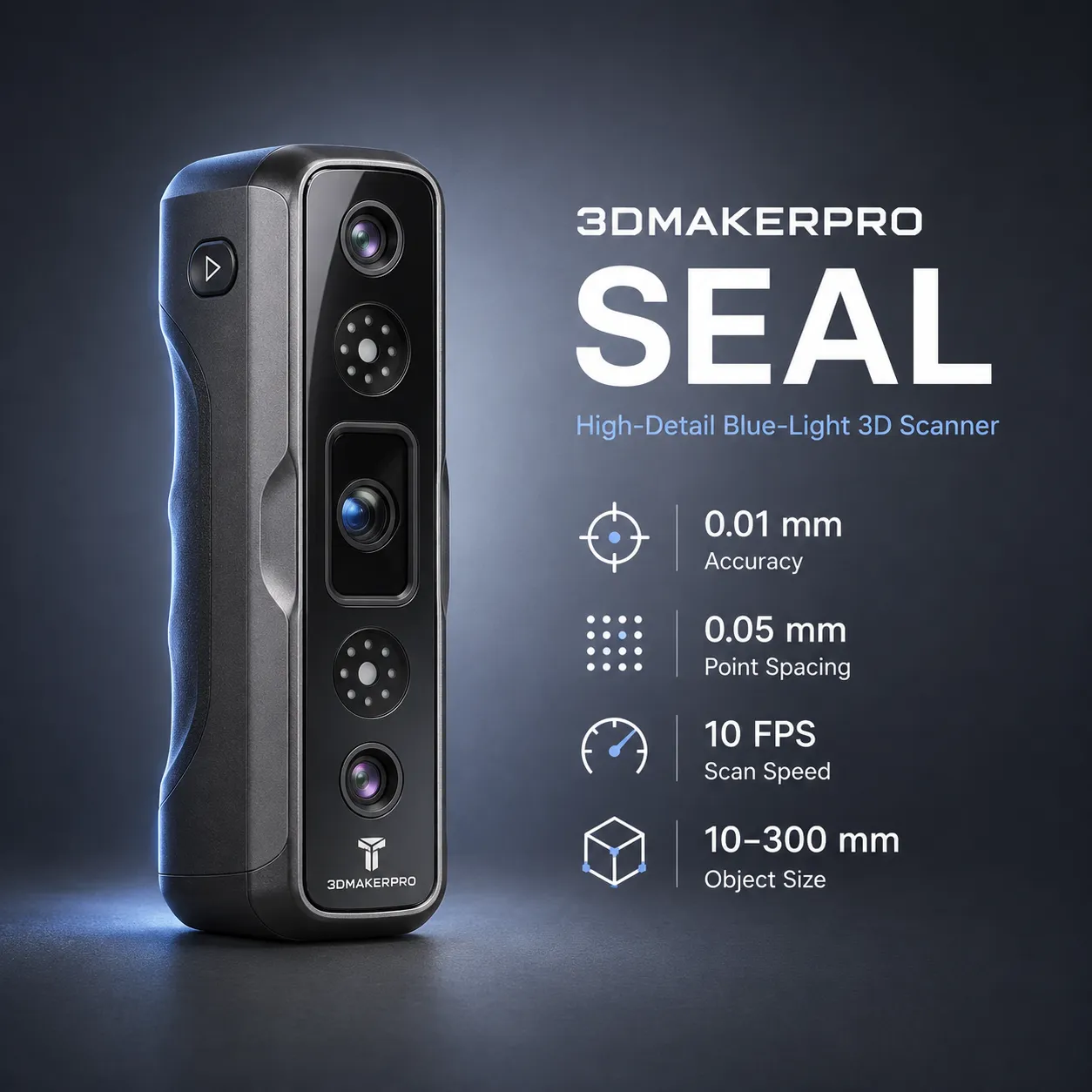
| 3DMakerpro Seal | Blue structured light | 0.01 mm | 180–280 mm | PC/mobile + optional turntable | Jewelry and very small detail |
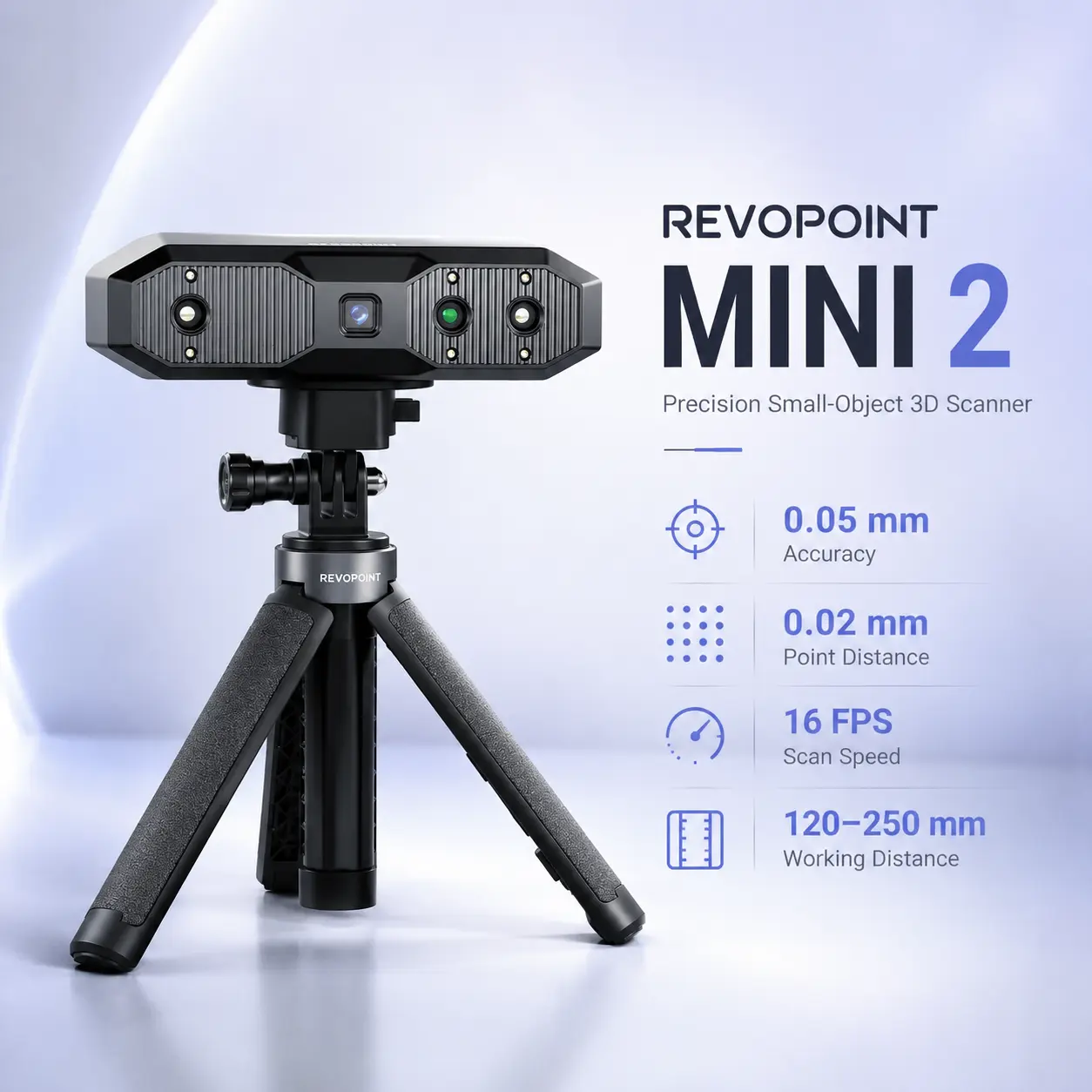
| Revopoint MINI 2 | Blue structured light | 0.05 mm | 120–250 mm | Handheld/desktop | Jewelry, miniatures, small objects |
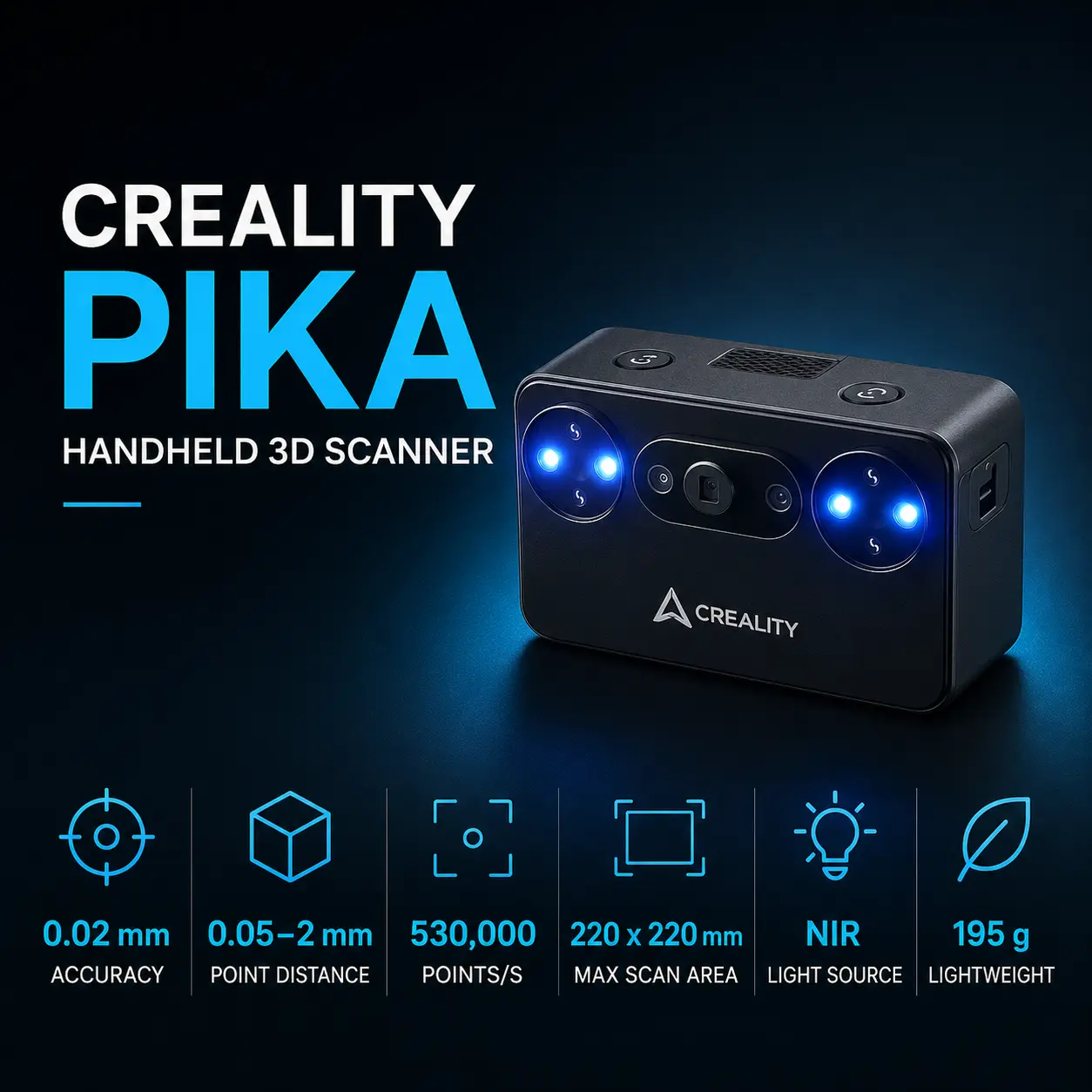
| Creality Pika | Blue laser + NIR | 0.03 mm laser | Mode-dependent | Portable hybrid | Small-to-large mixed scanning |
| Revopoint INSPIRE 2 | Infrared laser + structured light | 0.05 mm | 150–400 mm depending on environment | Handheld/desktop | Portable small-to-medium scanning |
| Revopoint MetroX Pro | Blue multi-line laser + full-field blue light | 0.02 mm | 200–400 mm | PC-based professional workflow | Engineering and reverse engineering |
THREE's advantage is not raw handheld speed; it is the combination of focusable optics, onboard processing, color capture, turntable automation, browser compatibility, and distance-dependent capture.
The Matter and Form THREE vs 3DMakerpro Seal comparison is most relevant for buyers scanning small objects, jewelry, miniatures, and compact mechanical parts.
The 3DMakerpro Seal publishes 0.01 mm accuracy, 0.05 mm resolution, a 180–280 mm working distance, and up to 10 FPS capture.
THREE publishes 0.033 mm close-range Z accuracy and emphasizes focusable cameras, standalone processing, automatic/point-pick alignment, a bundled motorized turntable, color capture, and browser-based control.
Choose Seal when the smallest nominal accuracy specification and a dedicated small-object workflow are the priority. Choose THREE when standalone processing, multi-platform browser access, integrated turntable scanning, and flexibility across object sizes matter more.
The Matter and Form THREE vs Revopoint MINI 2 comparison separates a self-contained structured-light workstation from a lightweight handheld/desktop scanner.
The Revopoint MINI 2 offers 0.05 mm single-frame accuracy, 0.02 mm precision, a 120–250 mm working distance, Wi-Fi 6, and up to 16 FPS scanning.
MINI 2 is especially well suited to jewelry, miniatures, and small objects. THREE is stronger when onboard processing, browser-based access, focusable optics, integrated turntable automation, larger capture areas at increased distance, and API capabilities matter more.
The Matter and Form THREE vs Creality Pika comparison is mainly about desktop structured-light flexibility versus hybrid laser/NIR portability.
The Creality Pika combines blue laser and NIR scanning, making it better suited to a wider range of object sizes and outdoor laser workflows.
THREE is stronger when turntable automation, browser-based control, full-color structured-light capture, mixed operating-system compatibility, and on-device processing are priorities.
Pika is the stronger choice for users who prioritize portable hybrid scanning and fast handheld laser capture.
The Matter and Form THREE vs Revopoint INSPIRE 2 comparison is useful for buyers choosing between standalone structured-light scanning and portable infrared scanning.
The Revopoint INSPIRE 2 publishes 0.05 mm single-frame accuracy, 0.03 mm precision, and up to 90 FPS in infrared laser mode. It also supports outdoor operation under specified conditions.
THREE is much slower per viewpoint but offers 0.033 mm close-range Z accuracy, focusable 13 MP cameras, local onboard processing, automated turntable capture, and operating-system independence.
Choose INSPIRE 2 for faster handheld scanning and portable outdoor-capable workflows. Choose THREE for controlled scanning where color, turntable automation, and standalone processing matter more than frame rate.
The Matter and Form THREE vs Revopoint MetroX Pro comparison is relevant to reverse-engineering users deciding between a flexible standalone structured-light system and a more specialized professional laser scanner.
The Revopoint MetroX Pro publishes up to 0.02 mm accuracy, 0.02 mm + 0.04 mm × L volumetric accuracy, up to 30 crossed blue laser lines, 15 parallel lines, and full-field structured-light scanning.
MetroX Pro is better suited to engineering surfaces, high-density laser capture, marker workflows, and tighter published volumetric accuracy. THREE is more attractive when browser independence, integrated color capture, focusable cameras, local processing, and automated turntable scanning are the deciding factors.
The best Matter and Form THREE alternative depends on which part of its workflow you want to replace.
For broader buying guidance, see Best 3D Scanners for Reverse Engineering in 2026 and 3D Scanner Accuracy vs Resolution.
Matter and Form THREE starts from US$2,399. Approximate regional equivalents: North America: US$2,399 / C$3,329 · Europe: €2,074 / £1,774 · Middle East: AED 8,810 · Australia: A$3,397 · India: ₹228,986.
Available through Matter and Form and regional sellers. Final prices vary with taxes, shipping, exchange rates, and promotions. Currency conversions are approximate.
Recommended use: Choose Matter and Form THREE when you want a self-contained structured-light scanner that combines close-range detail, full-color capture, focusable optics, browser-based control, automated turntable scanning, and local processing without requiring a dedicated workstation or cloud subscription.
Stereo structured light with focusable 13 MP Sony cameras and a DLP MEMS projector.
Matter and Form specifies 33 µm Z accuracy at a 220 mm scanner-to-object distance.
No. Published Z accuracy is 0.033 mm at 220 mm, 0.15 mm at 400 mm, and 0.4 mm at 700 mm.
Matter and Form publishes 0.037 mm at 220 mm, 0.065 mm at 400 mm, and 0.114 mm at 700 mm.
A single capture takes about 4 seconds, followed by roughly 10–15 seconds of onboard processing.
No. Scan processing runs on the scanner and the interface is accessed through a modern web browser.
No. Core scanning and processing run locally.
Matter and Form states that the core scanning workflow does not require an annual software subscription.
Yes. ChromaSpec and the 13 MP cameras support full-color textured models.
Not for normal feature-rich objects. It supports automatic feature-based alignment and manual point-pick alignment.
Yes. The current package includes a wired motorized turntable rated for objects up to 20 lb.
Matter and Form lists indoor and shaded-outdoor scanning. Direct sunlight is not the preferred environment for projected structured light.
OBJ, PLY, XYZ, GLTF, DAE, STL, and FBX.
Any operating system or device that supports a compatible modern web browser.