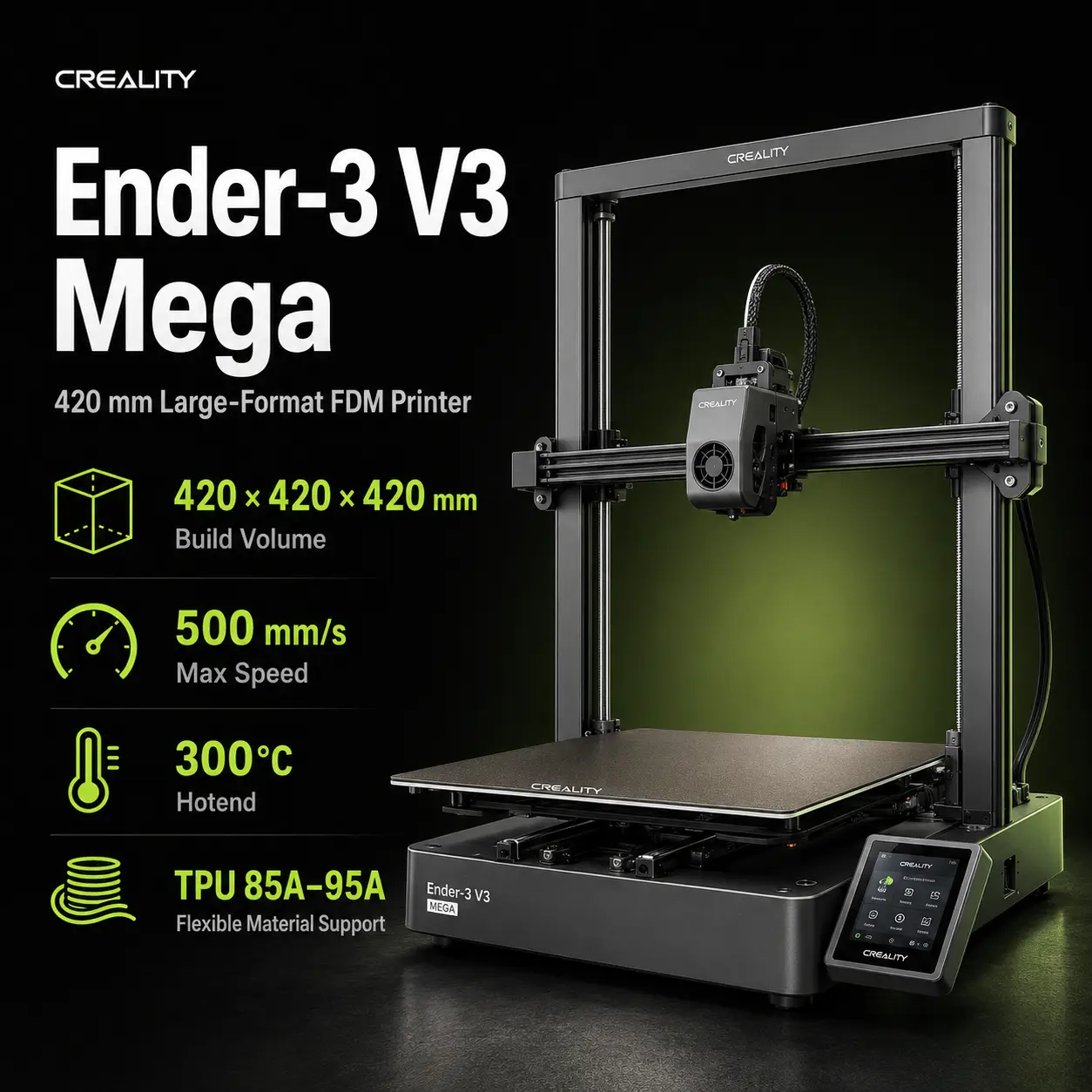
420 mm Cubic Build Volume500 mm/s High-Speed PrintingFlexible TPU 85A–95A SupportLarge-Format Direct Drive81-Point Auto LevelingWorkshop-Scale FDM Printing
CCreality
Creality
# Creality Ender-3 V3 Mega
The Creality Ender-3 V3 Mega is a 420 mm-class open-frame FDM/FFF printer aimed at users who need very large parts, long production runs, or unusually soft TPU capability. Creality launched the machine in China in 2026 with a 420 × 420 × 420 mm build volume, 500 mm/s maximum print speed, and 8,000 mm/s² maximum acceleration.
Its other headline feature is flexible-material handling. Creality's launch material focuses on TPU from 85A to 95A, supported by an upgraded second-generation Sprite direct-drive extruder with revised drive gears and a short, low-resistance filament path.
The machine also combines a 300°C hotend, 100°C heated bed, 81-point automatic bed probing, input-shaping/vibration compensation, filament runout and tangle detection, Wi-Fi, USB transfer, Creality Cloud integration, and Creality Print 7.0 fleet-management features.
For current launch information, see the official Creality Ender-3 V3 Mega announcement. For large costume-printing guidance, see Best 3D Printers for Cosplay Props and Helmets in 2026.
| Specification | Value |
|---|---|
| Printing technology | FDM / FFF |
| Printer design | Large open-frame Cartesian / moving-bed platform |
| Build volume | 420 × 420 × 420 mm |
| Maximum print speed | 500 mm/s |
| Typical-speed figure | Approx. 300 mm/s |
| Maximum acceleration | 8,000 mm/s² |
| Standard nozzle | 0.4 mm |
| Maximum nozzle temperature | 300°C |
| Maximum bed temperature | 100°C |
| Extruder | Upgraded Sprite direct drive |
| Flexible-material focus | TPU 85A–95A |
| Bed leveling | Full automatic leveling |
| Probe grid | 81 points |
| Motion compensation | Input shaping / vibration optimization |
| Frame | Aluminum-alloy gantry |
| Bed structure | Integrated die-cast heated bed |
| Display | 3.2-inch touchscreen |
| Connectivity | 2.4 GHz Wi-Fi / USB |
| Remote platform | Creality Cloud |
| Slicer / management | Creality Print 7.0 |
| Machine dimensions | 590 × 588 × 697.5 mm |
| Net weight | 20.2 kg |
| Published rated power | 1,150 W |
| China launch price | ¥3,399 CNY |
Speed note: 500 mm/s is the maximum published print-speed figure. Large objects, soft TPU, high-flow requirements, and heavy moving-bed loads may call for substantially lower real-world speeds.
The defining advantage of the Ender-3 V3 Mega is its 420 mm cubic build volume.
That size can reduce model splitting for cosplay helmets, masks, armor sections, large housings, workshop fixtures, RC/robotics components, architectural models, product prototypes, display pieces, and batch-production plates.
A 420 mm XY area is especially useful for wearable and prop work because fewer splits mean fewer joints to align, glue, reinforce, fill, sand, and hide.
The large bed also increases risk. A late failure on a 420 mm part can waste far more filament and time than a failed desktop-size job, so first-layer preparation, spool capacity, filament monitoring, and sensible speed settings matter.
Creality is positioning the Mega around more than build volume.
The upgraded Sprite extrusion path is designed to reduce the buckling and feeding resistance that make very soft TPU difficult to print.
Creality's launch messaging emphasizes 85A–95A TPU, covering applications such as flexible seals, protective covers, insoles, wearable components, vibration dampers, gaskets, soft grips, and flexible prototypes.
For a familiar 95A reference material, see Prusament TPU 95A.
Soft TPU performance still depends on filament dryness, geometry, flow rate, cooling, and slicer settings. The 85A capability should therefore be treated as a manufacturer-supported workflow rather than proof that every third-party 85A formulation will behave identically.
Current launch/specification reporting also lists PLA and PETG as mainstream materials, with ABS and ASA as higher-temperature options.
The Mega is open-frame, so its 300°C nozzle and 100°C bed do not provide the same thermal environment as an enclosed printer.
For large ABS or ASA parts, enclosure control is important because a 420 mm footprint creates large thermal gradients that can promote warping and layer splitting.
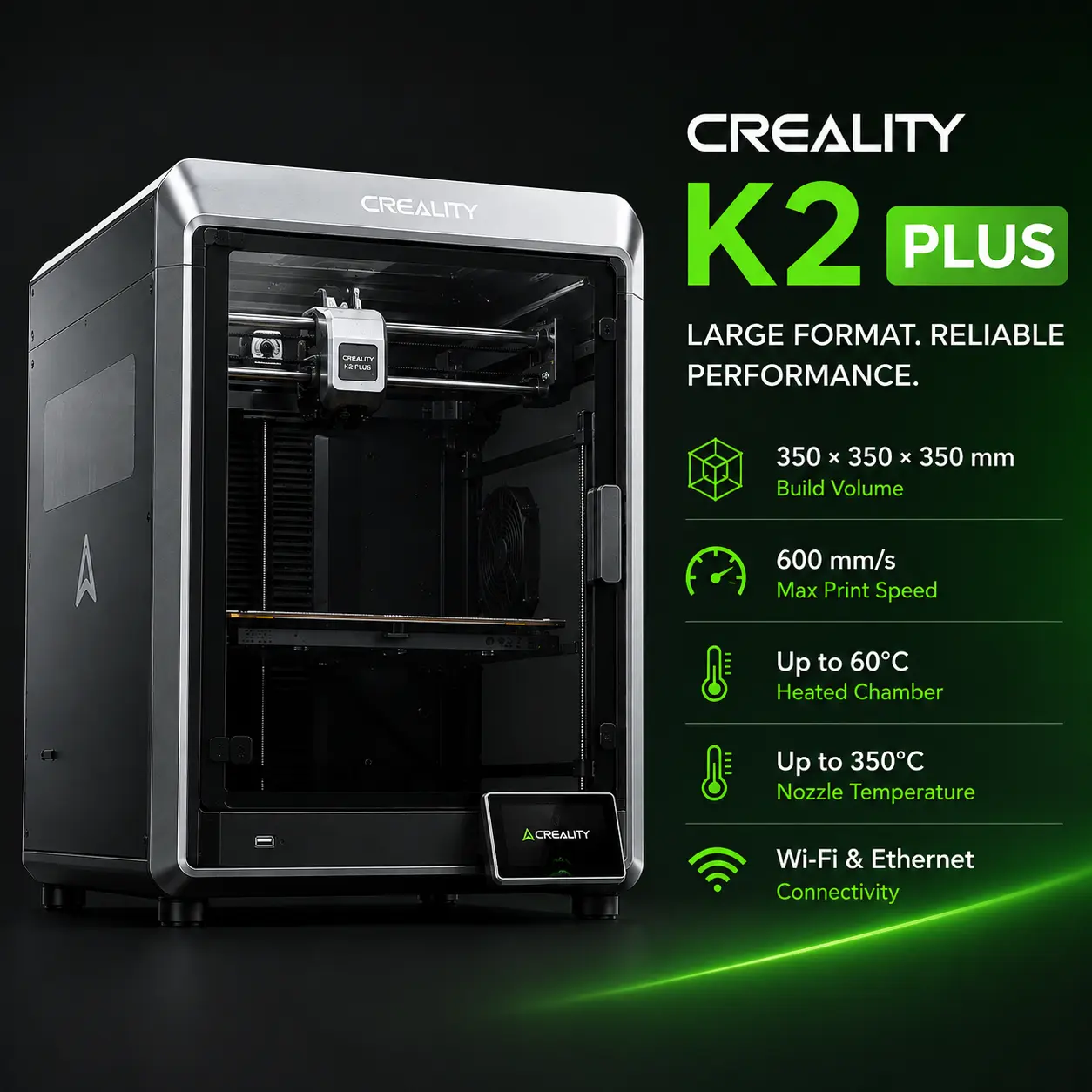
Users who regularly print large engineering polymers should compare the Mega with an enclosed platform such as the indexed Creality K2 Plus.
Large moving beds make first-layer consistency especially important.
Creality specifies 81-point automatic bed probing together with vibration/ringing compensation.
The printer also includes filament runout detection, filament tangle detection, automatic filament relay, Creality Cloud monitoring, and Creality Print 7.0 multi-printer management.
These features are particularly relevant to overnight prints, workshop production, and print farms where a single interrupted large job can consume significant time and material.
Automatic monitoring reduces operator workload but does not eliminate the need to inspect the first layer, keep filament dry, and verify spool capacity before a long build.
The Mega is positioned for more than one-off hobby prints.
Creality Print 7.0 supports network-based file dispatch and monitoring, while Creality Cloud provides remote access from mobile devices.
That combination can be useful in print farms, school labs, maker spaces, prop workshops, prototype studios, and small production environments.
A 420 mm printer can also batch many smaller parts on one plate, although a plate-wide failure can put more pieces at risk at once.
Current launch reporting describes the Ender-3 V3 Mega as compatible with Creality's expanding CFS / CFS nano ecosystem.
That should not be confused with the base printer including multi-color hardware.
CFS expansion is relevant for automatic filament switching, filament backup/relay, RFID spool recognition, and multi-color workflows where materials are compatible with the feed system.
The smaller CFS nano has been presented as a newer ecosystem component and regional availability can differ. Buyers should confirm exactly which CFS hardware is supported by the final regional Mega configuration before purchasing a multi-color add-on.
Soft TPU also deserves special attention because flexible filament is often restricted in automated multi-spool feed systems even when the printer itself can print it directly.
| Printer | Build Volume | Max Speed | Nozzle / Bed | Enclosure | Key Advantage |
|---|---|---|---|---|---|
| Creality Ender-3 V3 Mega | 420 × 420 × 420 mm | 500 mm/s | 300°C / 100°C | No | 420 mm cube + soft-TPU focus |
| Anycubic Kobra 3 Max | 420 × 420 × 500 mm | 600 mm/s | 300°C / 90°C | No | Taller Z + optional 4/8-color ACE Pro |
| ELEGOO Neptune 4 Max | 420 × 420 × 480 mm | 500 mm/s | 300°C / 85°C | No | Mature Klipper large-format platform |
| Creality Ender-3 V3 Plus | 300 × 300 × 330 mm | 600 mm/s | 300°C / 100°C | No | Smaller CoreXZ Ender alternative |
| Creality K2 Plus | 350 × 350 × 350 mm | 600 mm/s | 350°C / 120°C | 60°C active | Enclosed engineering-material workflow |
The Mega sits between raw-size machines and more expensive enclosed systems. Its clearest differentiators are the 420 mm cube, 100°C bed, and Creality's emphasis on very soft TPU.
The Ender-3 V3 Mega vs Anycubic Kobra 3 Max comparison is one of the strongest large-format buyer-intent searches.
The indexed Anycubic Kobra 3 Max provides a 420 × 420 × 500 mm build volume, giving it 80 mm more Z height than the Mega.
Anycubic also publishes 600 mm/s maximum speed, 300 mm/s recommended speed, 10,000 mm/s² acceleration, a 300°C hotend, 90°C PEI bed, LeviQ 3.0 automatic leveling, optional four/eight-color ACE Pro support, and 1,100 W rated power.
The Mega gives up Z height and headline speed but has a hotter 100°C bed and a stronger launch focus on soft TPU from 85A to 95A.
Choose Kobra 3 Max when maximum height, higher published motion figures, or optional ACE Pro multi-color printing matter most. Choose Ender-3 V3 Mega when 420 mm cubic capacity, 100°C bed capability, and soft-TPU optimization are the priorities.
The Ender-3 V3 Mega vs ELEGOO Neptune 4 Max comparison is especially close in raw dimensions.
The official ELEGOO Neptune 4 Max provides a 420 × 420 × 480 mm build volume, 500 mm/s maximum speed, 8,000 mm/s² acceleration, 300°C hotend, 85°C bed, Klipper, 121-point leveling, Wi-Fi/LAN/USB, and support for PLA, TPU, PETG, ABS, ASA, and Nylon.
Neptune 4 Max gives 60 mm more Z height and a mature Klipper workflow.
The Mega has a hotter 100°C bed and much stronger emphasis on soft TPU, plus Creality Print / Cloud fleet-management integration.
Choose Neptune 4 Max for extra Z height, established Klipper controls, and current global retail availability. Choose Ender-3 V3 Mega for soft TPU, the hotter bed, and Creality's newer production-management ecosystem.
The Ender-3 V3 Mega vs Ender-3 V3 Plus comparison is the clearest same-family decision.
The official Ender-3 V3 Plus provides a 300 × 300 × 330 mm build volume and uses Creality's CoreXZ architecture.
Creality publishes up to 600 mm/s speed, 20,000 mm/s² acceleration, a 300°C nozzle, and a 100°C bed for the Plus.
The V3 Plus is substantially smaller, lighter, and more established internationally. The Mega increases the build volume to 420 × 420 × 420 mm and shifts the product emphasis toward large production work and soft TPU.
Worth waiting for Ender-3 V3 Plus if 300 mm XY capacity is enough, and a smaller, established machine is preferable. Choose Ender-3 V3 Mega when one-piece helmets, larger props, big prototypes, or high-volume TPU work justify the extra footprint.
The Ender-3 V3 Mega vs Creality K2 Plus comparison is raw open-frame size versus enclosed engineering capability.
The indexed Creality K2 Plus provides a smaller 350 × 350 × 350 mm build volume but adds fully enclosed CoreXY construction, a 350°C nozzle, 120°C bed, 60°C active chamber heating, 600 mm/s maximum speed, and CFS support up to 16 colors.
The Mega offers more XY and Z space and a lower China launch price, but it lacks the K2 Plus thermal environment.
Worth waiting for Ender-3 V3 Mega for oversized PLA/PETG/TPU parts, cosplay, and open-frame large-format production. Choose K2 Plus for ABS, ASA, PA, PC, reinforced materials, enclosure-controlled production, and CFS expansion.
The machine has launched and is being sold in China, but a confirmed US/global retail price has not yet been announced.
420 × 420 × 420 mm.
Creality publishes up to 500 mm/s, with approximately 300 mm/s used as the typical speed figure in current launch specifications.
8,000 mm/s².
300°C.
100°C.
Current launch specifications identify a 0.4 mm nozzle.
Yes. Creality's launch material emphasizes TPU from 85A to 95A.
Creality uses an upgraded Sprite direct-drive extruder with revised drive gears and a short, low-resistance filament path intended to reduce soft-filament buckling.
Yes. Current launch specifications describe 81-point automatic leveling.
Yes. Current specifications list 2.4 GHz Wi-Fi plus USB transfer and Creality Cloud integration.
No. It is an open-frame, large-format printer.
Current launch specifications list them as compatible, but large parts benefit from enclosure control because the printer itself is open.
Current launch reporting describes CFS and CFS nano ecosystem compatibility. Buyers should confirm the exact regional hardware bundle before ordering an add-on.
Kobra 3 Max is taller at 500 mm and has a higher published speed and acceleration. The Mega has a hotter 100°C bed and stronger soft-TPU positioning.
Neptune 4 Max is taller and already has a mature global Klipper workflow. Mega has a hotter bed and a stronger 85A–95A TPU focus.
V3 Plus is smaller at 300 × 300 × 330 mm but faster on paper and more widely established. Mega is designed for much larger parts and softer TPU.
A confirmed US/global retail price has not yet been announced.