Wireless Standalone Metrology ScannerHigh-Speed Blue Laser ScannerHybrid Laser IR ScannerLarge-Area Metrology ScannerIndustrial Precision 3D ScannerMarker-Free Large-Part Scanner
SSHINING 3D
SHINING 3D
# SHINING 3D FreeScan Omni Lite
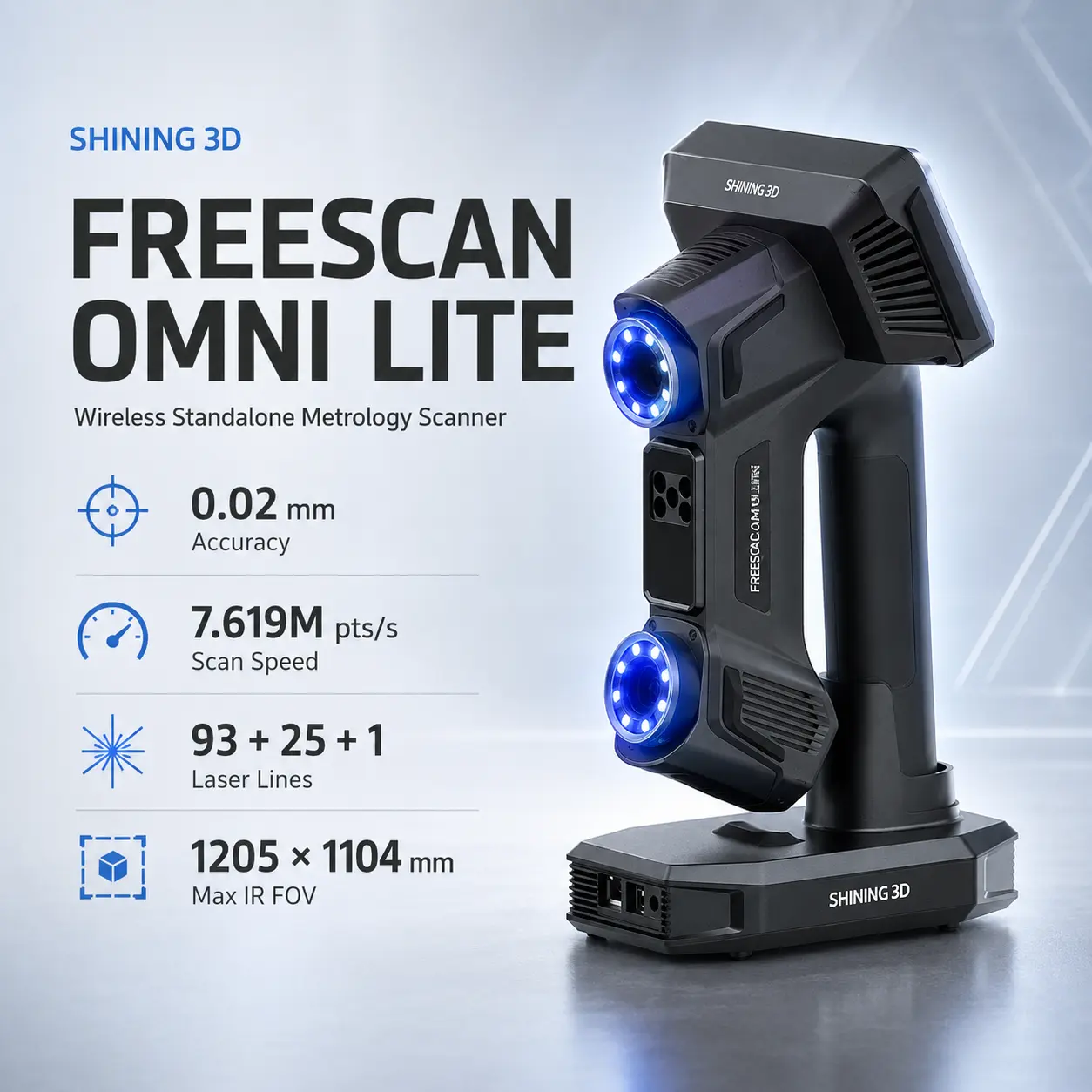
The SHINING 3D FreeScan Omni Lite is a wireless, standalone handheld metrology scanner built for industrial inspection, reverse engineering, manufacturing QA, automotive work, heavy equipment, aviation, and field measurement. It combines blue-laser scanning, IR VCSEL marker-free scanning, onboard computing, a 5.5-inch touchscreen, detachable hot-swappable batteries, and both standalone and PC-connected workflows.
Omni Lite shares the same core hardware platform and scanning performance as the flagship FreeScan Omni, but it is sold as the modular entry configuration. The scanner's core four-mode scanning system is included, while SHINING3D Inspect for PC, on-device inspection, Video Photogrammetry (VPG), and AI Feature Recognition are optional modules on Omni Lite rather than standard bundled functions.
SHINING 3D publishes 0.02 mm accuracy, 0.02 + 0.03 mm/m volumetric accuracy, scanning speeds up to 7,619,000 points/s, and a 0.01–10 mm resolution range. With the optional VPG module, volumetric extension accuracy is specified at 0.02 + 0.015 mm/m.
The scanner provides four acquisition modes: 93-line high-speed laser, 25-line detailed laser, single-line deep-pocket scanning, and IR Rapid mode for marker-free capture. Maximum published field of view reaches 580 × 650 mm in laser mode and 1205 × 1104 mm in IR mode, with a total depth-of-field span from 170 to 1000 mm.
For current product information, see the official FreeScan Omni Series page.
| Specification | Value |
|---|---|
| Scanner type | Handheld metrology scanner |
| Light sources | Blue laser + IR VCSEL |
| Accuracy | 0.02 mm |
| Volumetric accuracy | 0.02 + 0.03 mm/m |
| Volumetric extension accuracy with VPG | 0.02 + 0.015 mm/m |
| Maximum scan speed | 7,619,000 points/s |
| Published resolution range | 0.01–10 mm |
| High-speed mode | 93 laser lines |
| Detailed mode | 25 parallel laser lines |
| Deep-pocket mode | 1 laser line |
| IR mode | IR VCSEL Rapid Mode |
| Maximum laser FOV | 580 × 650 mm |
| Maximum IR FOV | 1205 × 1104 mm |
| Depth of field | 830 mm total, 170–1000 mm |
| Display | 5.5-inch touchscreen |
| Work modes | Standalone / PC-connected |
| Connection | Wireless / wired |
| Battery system | Detachable hot-swappable packs |
| Net weight | ≤1.1 kg |
| Protection | IP50 |
| Acceptance testing | VDI/VDE 2634 Part 3 and ISO 10360 |
| Calibration environment | ISO/IEC 17025-accredited accuracy laboratory |
| Core scanning software | FreeScan |
| Color texture camera | Not listed |
The 0.02 mm figure is the scanner's published accuracy specification. Volumetric accuracy is a separate length-dependent specification and becomes especially important when scanning larger parts.
Omni Lite includes the same four core modes as FreeScan Omni:
SHINING 3D publishes 0.02 mm accuracy, 0.02 + 0.03 mm/m volumetric accuracy, and 0.02 + 0.015 mm/m volumetric extension accuracy with optional VPG.
The 0.02 mm accuracy figure is not the same as the 0.01 mm minimum resolution setting. Resolution describes data density; volumetric accuracy becomes increasingly important as measured length grows.
SHINING 3D states that Omni Series acceptance testing is based on VDI/VDE 2634 Part 3 and ISO 10360, with calibration and verification in its ISO/IEC 17025-accredited Accuracy Laboratory.
Production users should still consider calibration status, environment, part temperature, marker layout, software settings, and required uncertainty.
Scanning and processing can run directly on Omni Lite without a permanently connected computer. The 5.5-inch touchscreen handles local control, while wired and PC-connected modes remain available.
SHINING 3D states that the Omni platform uses four batteries at a time and ships with eight rechargeable batteries. One set supports about one hour of continuous scanning, with hot swapping intended to avoid shutdown.
The most important buying distinction is that Omni Lite is not simply a slower Omni.
SHINING 3D states that Omni Lite uses the same hardware foundation and core scanning modes as the flagship model. The difference is the included software and advanced measurement functionality.
| Feature | FreeScan Omni Lite | FreeScan Omni |
|---|---|---|
| Core scanning hardware | Same platform | Same platform |
| 0.02 mm accuracy | Included | Included |
| 7.619M points/s maximum | Included | Included |
| Standalone + PC modes | Included | Included |
| Four scanning modes | Included | Included |
| SHINING3D Inspect for PC | Optional module | Included |
| On-device inspection | Optional module | Included |
| Video Photogrammetry | Optional module | Included |
| AI Feature Recognition | Optional module | Included |
This makes Omni Lite attractive to organizations that need professional scanning immediately but want to add inspection, VPG, or AI measurement functions later.
On Omni Lite, Video Photogrammetry, on-device inspection, AI Feature Recognition, and SHINING3D Inspect for PC are optional modules.
VPG uses a calibration rod and real-time marker verification for large objects and is specified at 0.02 + 0.015 mm/m volumetric extension accuracy. Without VPG, the standard volumetric figure remains 0.02 + 0.03 mm/m.
AI Feature Recognition targets common geometry such as round holes, rectangular holes, and slots. The modular approach lets buyers add inspection/reporting functions later rather than purchasing the complete flagship software package immediately.
SHINING 3D positions Omni Series for many black, metallic, and reflective industrial surfaces. Mirror-like, transparent, or exceptionally reflective materials may still require preparation.
High-speed laser capture, wide IR coverage, wireless operation, and optional VPG make Omni Lite suitable for vehicle panels, castings, heavy equipment, machine frames, aerospace structures, large molds, and tooling.
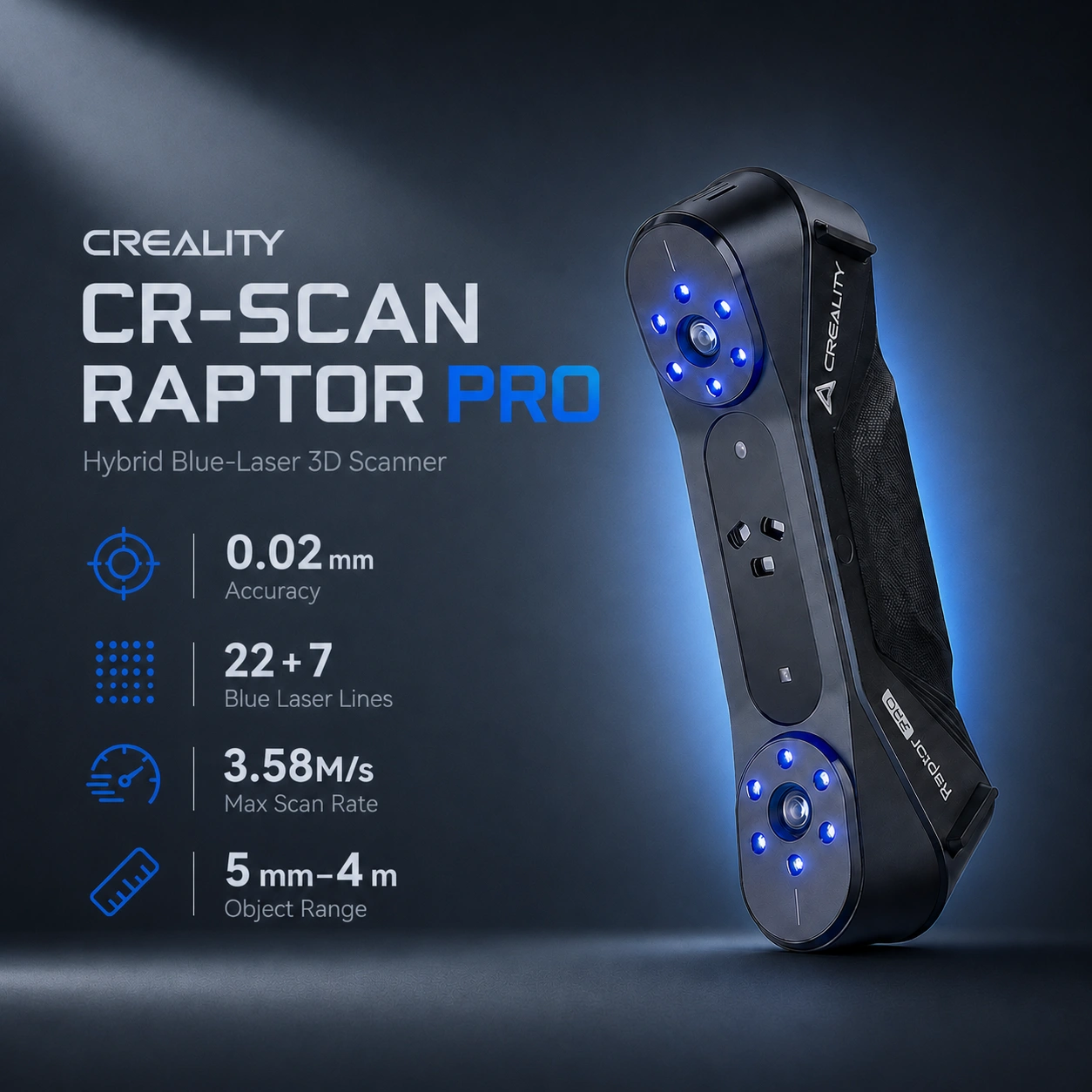
For different large-part workflows, compare the Revopoint Trackit SR and Creality CR-Scan Raptor Pro.
FreeScan handles acquisition, alignment, processing, and meshing. Downstream options include SHINING3D Inspect, PolyWorks Inspector, Geomagic Control X, EXModel Pro, Geomagic Design X, and BlueStar Mapping. Common exports include ASC, STL, PLY, OBJ, and 3MF.
For lower-cost small-to-medium engineering work, compare the indexed Revopoint MetroX Pro.
SHINING 3D's current Omni specification does not list an integrated RGB texture camera. Omni Lite is therefore geometry-focused rather than a photorealistic color scanner.
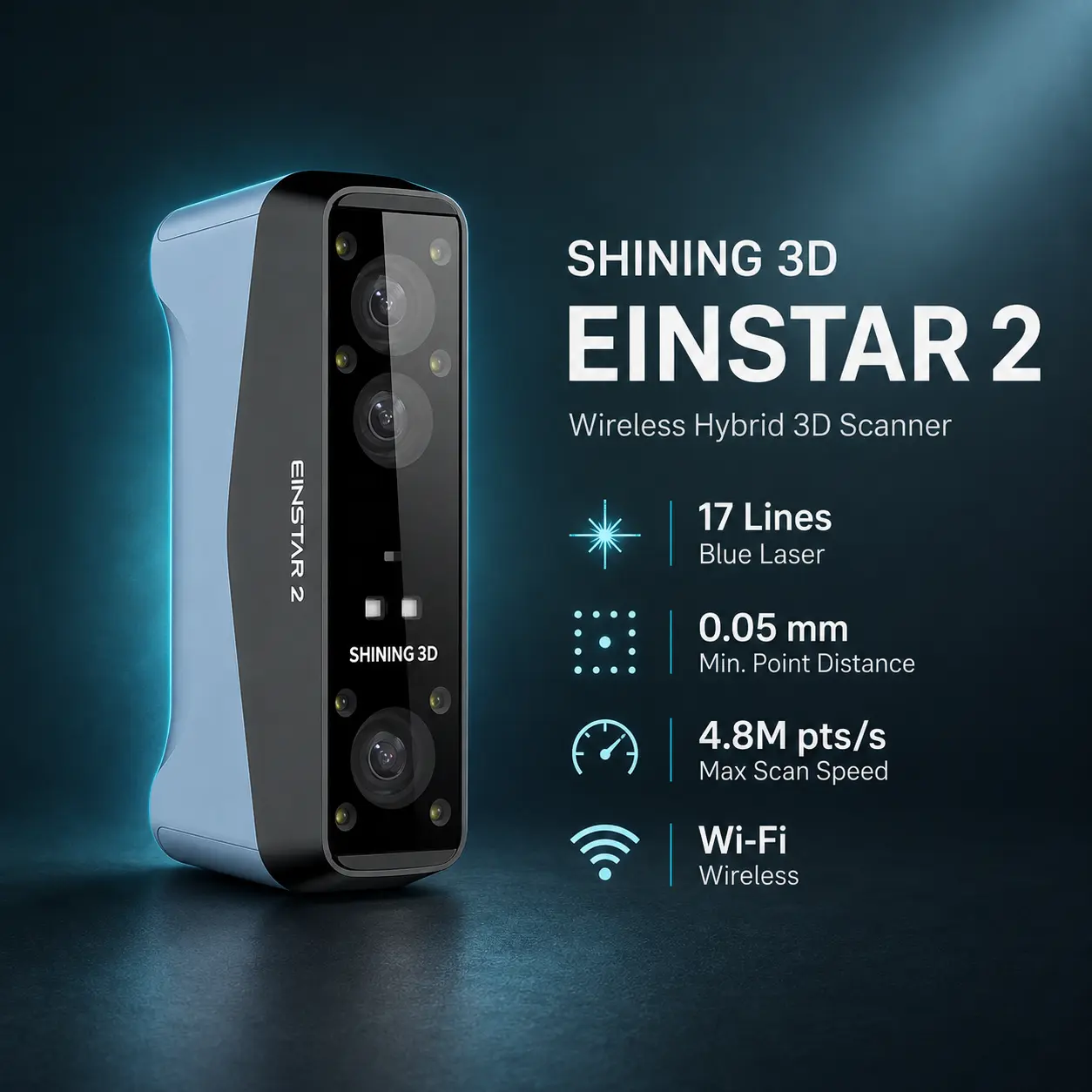
For full-color scanning, the indexed SHINING 3D EINSTAR 2 targets a different accuracy and application class.
| Scanner | Published Accuracy | Maximum Scan Rate | Core Workflow | Standalone | Main Strength |
|---|---|---|---|---|---|
| FreeScan Omni Lite | 0.02 mm | 7.619M points/s | 93-line + 25-line + single-line + IR VCSEL | Yes | Standalone modular metrology |
| FreeScan Omni | 0.02 mm | 7.619M points/s | Same core hardware + full inspection modules | Yes | Complete scan-to-inspect package |
| FreeScan Trio | 0.02 mm with markers | 3.01M points/s | 98-line marker-free laser + detailed modes | No standalone platform | Marker-free laser scanning |
| FreeScan UE Pro2 | 0.02 mm | 3.46M points/s | 50-line wireless laser + VPG | No standalone platform | Lightweight wireless metrology |
| Artec Point II | 0.02 mm | 5.8M measurements/s | 54-line + 17-line + single laser | No | Premium compact target-based laser |
| Revopoint Trackit SR | 0.02 mm single-frame | 2.0M points/s | Blue laser + NIR optical tracking | Standalone marker mode only | Wireless marker-free optical tracking |
| Revopoint MetroX Pro | 0.02 mm single-frame | 7.0M points/s full-field | Blue laser + full-field blue light | No | Lower-cost small/medium engineering |
Scan-rate figures are not directly interchangeable because acquisition and tracking methods differ.
The FreeScan Omni Lite vs FreeScan Omni difference is included software, not core scanning hardware. Both share 0.02 mm accuracy, 7.619M points/s, standalone operation, and four scan modes.
Omni includes SHINING3D Inspect for PC, on-device inspection, VPG, and AI Feature Recognition. Those are optional on Lite.
Choose Lite for modular expansion; choose Omni for a complete scan-to-inspect package from day one.
Official comparison: FreeScan Omni Series.
The FreeScan Omni Lite vs FreeScan Trio comparison is standalone modular metrology versus marker-free laser specialization.
The FreeScan Trio publishes 0.02 mm accuracy with markers, 3.01M points/s, 650 × 580 mm FOV, and a 98-line marker-free laser mode.
Choose Omni Lite for standalone operation and higher headline throughput; choose Trio when marker-free blue-laser scanning is the priority.
The FreeScan Omni Lite vs FreeScan UE Pro2 comparison is standalone computing versus a lighter wireless laser scanner.
The FreeScan UE Pro2 weighs about 950 g, uses 50 laser lines, reaches 3.46M points/s, and supports VPG at 0.02 + 0.015 mm/m.
Choose Omni Lite to eliminate the host computer; choose UE Pro2 for a lighter wireless laser/VPG workflow.
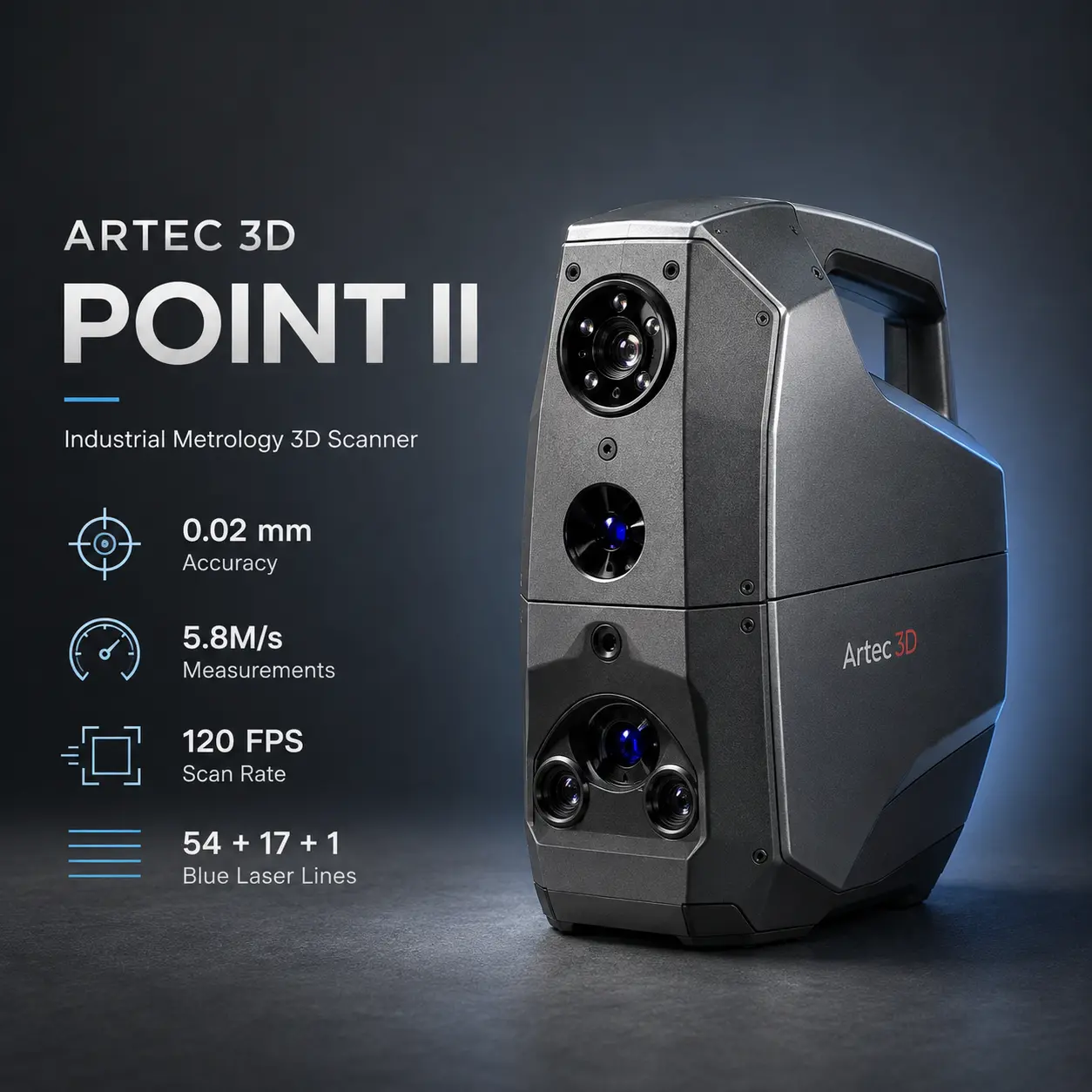
The FreeScan Omni Lite vs Artec Point II comparison is standalone hybrid metrology versus premium target-based laser scanning.
The Artec Point II publishes 0.02 mm accuracy/resolution, 5.8M measurements/s, 120 FPS, 54-line/17-line/single-line laser modes, a 570 g body, and 700 × 600 mm scanning area.
Choose Omni Lite for standalone laser/IR workflows; choose Point II for a lighter target-based scanner and Artec Studio ecosystem.
The FreeScan Omni Lite vs Revopoint Trackit SR comparison is especially relevant to large-part field metrology.
The Revopoint Trackit SR publishes 0.02 mm single-frame accuracy, 0.025 + 0.04 mm × L tracking volumetric accuracy, 2.0M points/s, and a 3 m³ tracking volume.
Choose Omni Lite for a single-device standalone workflow; choose Trackit SR when marker-free optical tracking around large workpieces is the priority.
SHINING 3D sells FreeScan Omni Lite on a quotation basis through its metrology sales network and authorized partners. Cost depends on software modules, VPG, inspection options, service, training, workstation requirements, and region.
The model remains part of the active FreeScan Omni Series.
It is the modular entry configuration of SHINING 3D's wireless standalone FreeScan Omni metrology platform.
0.02 mm, with standard volumetric accuracy of 0.02 + 0.03 mm/m.
SHINING 3D publishes 0.02 + 0.015 mm/m volumetric extension accuracy when VPG is added.
Up to 7,619,000 points/s.
93-line high-speed laser, 25-line detailed laser, single-line deep-pocket, and IR Rapid.
Yes. IR Rapid is intended for marker-free scanning of suitable objects.
Yes. Standalone scanning and onboard processing are core features.
Core scanning hardware and performance are the same, but Omni includes SHINING3D Inspect, on-device inspection, VPG, and AI Feature Recognition; those are optional on Lite.
SHINING 3D does not list an integrated RGB texture camera.
Yes. SHINING 3D lists VDI/VDE 2634 Part 3 and ISO 10360 acceptance testing in an ISO/IEC 17025-accredited accuracy laboratory.
Pricing is provided through SHINING 3D and authorized metrology resellers on a quotation basis.