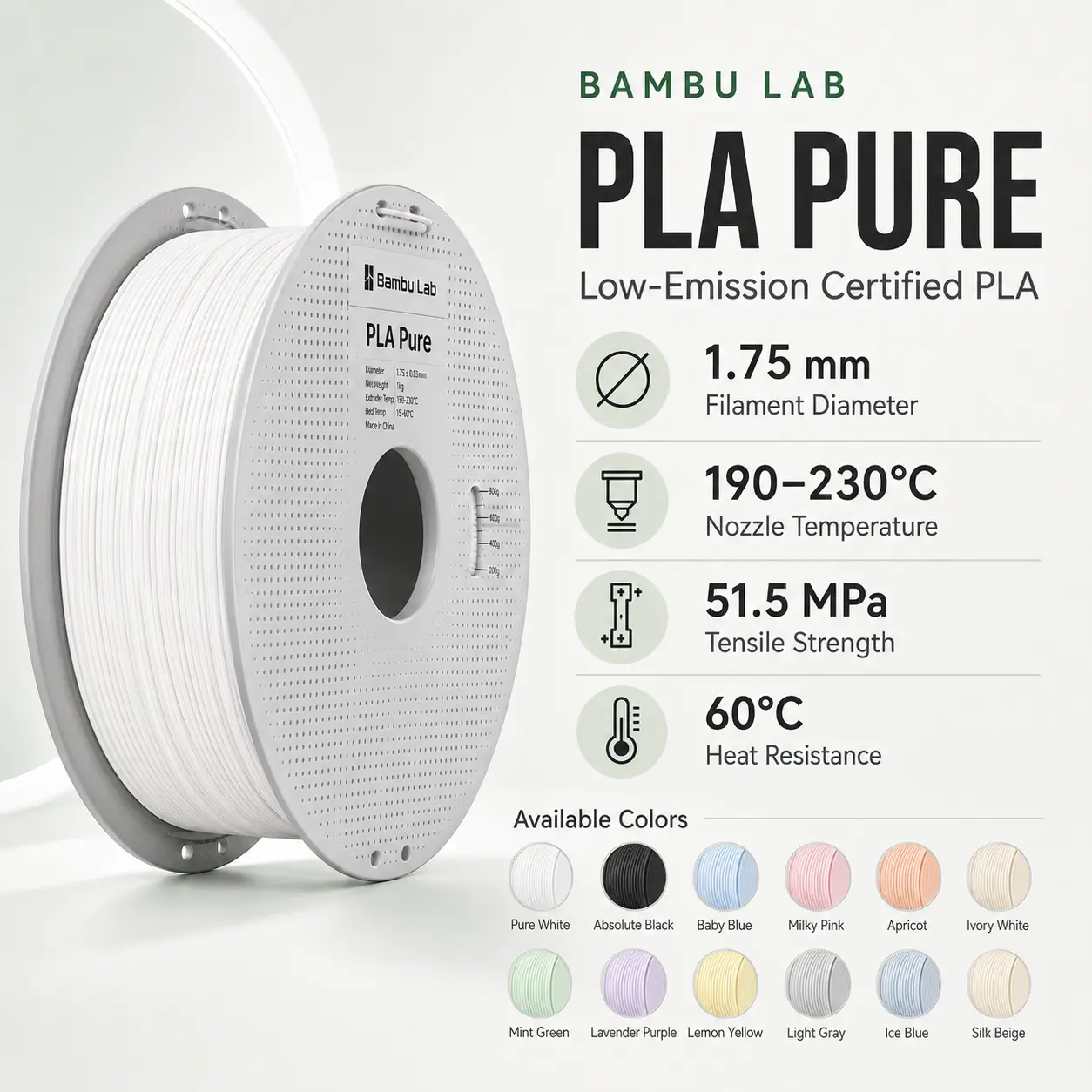
Low-Emission Certified PLAClean-Formula PLA FilamentIndoor-Friendly PLA MaterialFive-Ingredient PLAToy-Safety Tested PLAFood-Contact Compliant PLA
BBambu Lab
Bambu Lab
# Bambu Lab PLA Pure
Bambu Lab PLA Pure is a 1.75 mm PLA filament for home, education, prototypes, toys, household objects, and other general-purpose FDM printing where low emissions and ingredient traceability matter.
Bambu Lab uses a five-ingredient formulation and states that each ingredient is traceable to applicable EU food-contact lists. PLA Pure is also certified to UL GREENGUARD / UL 2904 for low printing emissions and has EN 71-3 toy-safety testing. Bambu additionally publishes EU No. 10/2011 migration testing for printed PLA Pure samples under defined test conditions.
Those documents do not mean every user-made object is automatically food safe. Final suitability depends on printer and nozzle cleanliness, build surface, post-processing, geometry, temperature, and the actual contact scenario. Bambu specifically warns that ordinary layered FFF parts are not suitable for holding liquid foods.
Mechanically, PLA Pure remains a conventional rigid PLA rather than a high-temperature engineering polymer. Bambu publishes 51.5 MPa XY tensile strength, 5.6% XY elongation at break, and 60°C HDT at 0.45 MPa.
For current product data, see the official Bambu Lab PLA Pure page and PLA Pure Advanced Printing Guide.
| Specification | Value |
|---|---|
| Material | PLA filament |
| Printing process | FDM / FFF |
| Diameter | 1.75 ± 0.03 mm |
| Format | 1 kg spool or refill |
| Nozzle temperature | 190–230°C |
| Bed temperature | 35–65°C |
| Chamber temperature | 25–40°C |
| Published print speed | Below 200 mm/s |
| XY tensile strength | 51.5 ± 2 MPa |
| Z tensile strength | 30.0 ± 3 MPa |
| XY Young's modulus | 2481 ± 20 MPa |
| Z Young's modulus | 2196 ± 25 MPa |
| XY elongation at break | 5.6 ± 1.0% |
| XY flexural strength | 75 ± 2 MPa |
| Z flexural strength | 55 ± 5 MPa |
| XY flexural modulus | 2880 ± 100 MPa |
| XY impact strength | 20.6 ± 0.7 kJ/m² |
| HDT at 0.45 MPa | 60°C |
| HDT at 1.8 MPa | 56°C |
| Glass transition temperature | 55°C |
| Vicat softening temperature | 63°C |
| Density | 1.24 g/cm³ |
| Drying | 50°C for 8 hours when needed |
| Storage | Sealed and dry; below 20% RH recommended |
Mechanical values are manufacturer test results and are not universal design allowables for every print orientation, profile, or part geometry.
Bambu recommends:
PLA Pure is non-abrasive, so a hardened nozzle is not required solely because of the material. It also does not require an enclosure for normal printing.
Compatible indexed printers include the Bambu Lab A1, Bambu Lab A1 mini, Bambu Lab P2S, and Bambu Lab H2D.
PLA Pure is unusual among consumer PLA filaments because Bambu publishes both emissions and food-contact documentation.
Bambu states that PLA Pure is certified under UL 2904, which addresses particle and VOC emissions from 3D printing.
Low-emission certification does not eliminate the need for ventilation. Bambu's own safety guidance still recommends good ventilation or effective filtration/exhaust.
Bambu's documentation states that:
Bambu also explicitly states that it does not guarantee every user-produced print will meet food-contact requirements.
For contact-sensitive parts, the company discusses keeping equipment clean and using a dedicated clean non-brass nozzle to reduce contamination risk.
PLA Pure should therefore be described as food-contact tested PLA with documented ingredient compliance, not as a blanket guarantee that every printed object is food safe.
PLA Pure has undergone EN 71-3 testing related to migration of certain elements from toy materials. Finished-toy safety still depends on design, small parts, sharp edges, age suitability, and local requirements.
For buyers researching Bambu filament cost per gram, the published 1 kg PLA Pure list prices are:
| PLA Pure format | Price | Approx. cost per gram |
|---|---|---|
| Filament with reusable spool | US$24.99 / 1 kg | US$0.025/g |
| Refill | US$21.99 / 1 kg | US$0.022/g |
That is about 2.50 cents per gram with the spool and 2.20 cents per gram for the refill before tax or shipping.
Bambu frequently runs multi-roll and flash promotions, so real checkout cost can be lower. A refill is most useful after you already own a compatible reusable spool.
For regional reference, it costs approximately €21.42 in Europe, £18.43 in the United Kingdom, AED 91.78 in the UAE, C$34.61 in Canada, A$35.12 in Australia, and ₹2,389 in India. The refill is approximately €18.85, £16.22, AED 80.76, C$30.45, A$30.90 and ₹2,102. Actual regional prices may vary because of local pricing, taxes, shipping, promotions, and exchange-rate changes.
Users searching for Bambu filament, Bambu Lab filament, Bambu filaments, or Bambu PLA are choosing from a range that also includes PETG, ABS, ASA, TPU, nylon, PC, support materials, and fiber-reinforced blends.
PLA Pure is differentiated by its five-ingredient formula, low-emission certification, food-contact documentation, EN 71-3 testing, and AMS/RFID integration rather than by maximum speed or high-temperature performance.
The phrase “Bambu Labs filament” is a common search variation; the manufacturer name is Bambu Lab. For ordinary low-cost Bambu Lab PLA, standard PLA lines may offer broader colors and faster profiles.
The Bambu Lab AMS 2 Pro filament dryer is compatible with PLA Pure.
Bambu lists PLA Pure as compatible with:
The Bambu Lab AMS 2 Pro adds active drying up to 65°C, spool rotation, active moisture discharge, sealed storage, humidity monitoring, and RFID synchronization.
PLA Pure guidance is 50°C for 8 hours when drying is needed. Use the material-specific profile rather than the maximum dryer temperature. Bambu also states that AMS 2 Pro drying requires connection to a compatible printer; it is not a fully standalone dryer.
A common question is “does Bambu come with filament?”
It depends on the printer and bundle.
For example, Bambu's current A1 packaging list includes a 20 g sample filament, not a full 1 kg spool. Package contents vary by model and revision, so check the exact printer's What's in the Box list and order a full spool for normal use.
Bambu recommends drying PLA Pure at 50°C for 8 hours when moisture causes print-quality problems.
Moisture can cause stringing, popping, rough surfaces, or inconsistent extrusion. Store opened filament sealed with desiccant, preferably below 20% RH.
AMS 2 Pro and AMS HT provide active drying; original AMS and AMS Lite should not be described as equivalent dryers.
PLA Pure remains a low-temperature rigid PLA. Bambu publishes 51.5 MPa XY / 30 MPa Z tensile strength, 60°C HDT at 0.45 MPa, 56°C HDT at 1.8 MPa, 55°C Tg, and 63°C Vicat.
The XY/Z difference shows why print orientation matters. For tougher parts with more thermal margin, compare Prusament PETG.
| Material | Main Positioning | Mechanical / Strength Context | Heat Resistance | Typical Advantage |
|---|---|---|---|---|
| Bambu Lab PLA Pure | Low-emission, contact-safety-focused PLA | 51.5 MPa XY tensile | 60°C HDT @ 0.45 MPa | Emissions and compliance documentation |
| Bambu PLA Basic | General-purpose high-speed Bambu PLA | Similar general PLA strength class | About 57°C HDT @ 0.45 MPa | More colors and faster everyday PLA |
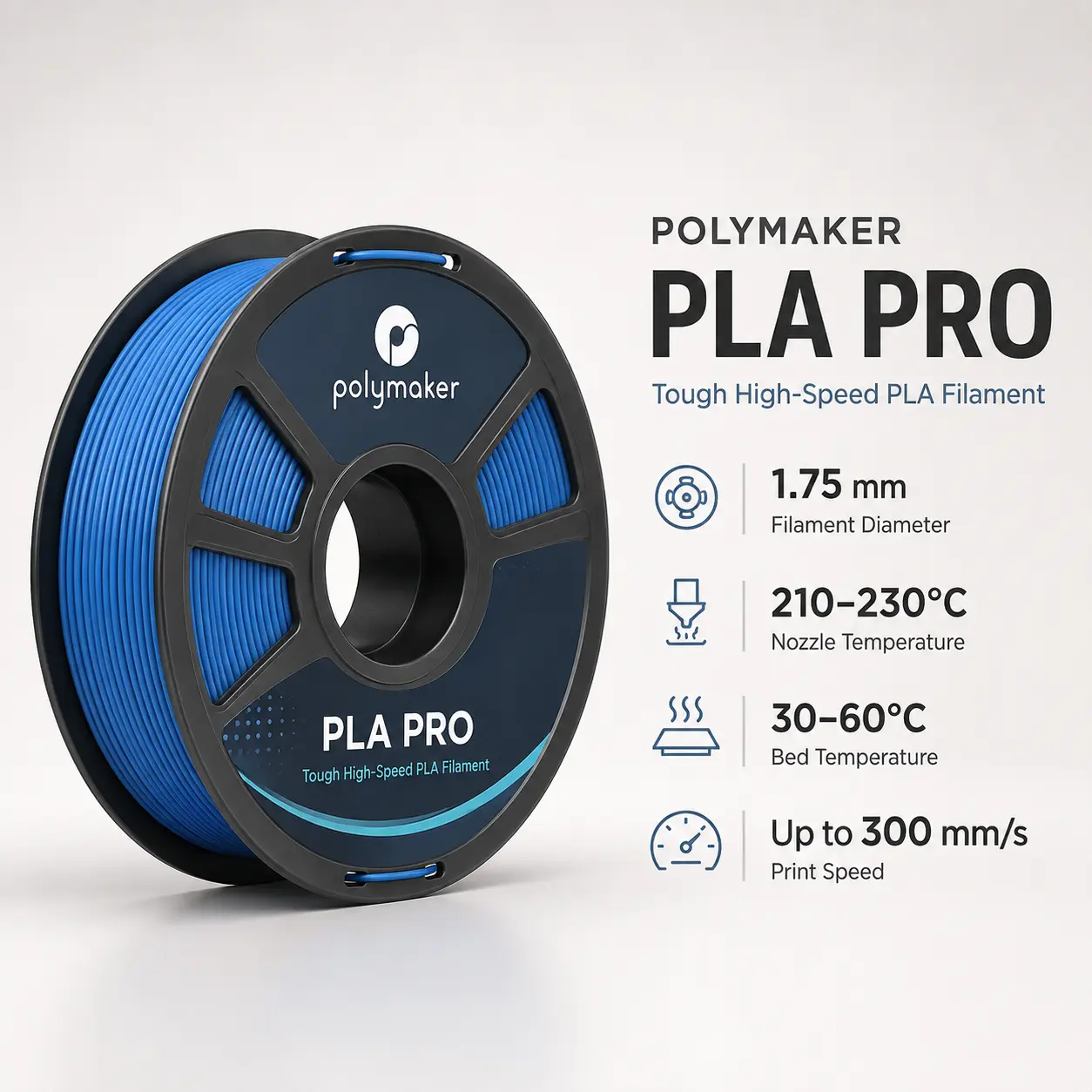
| Polymaker PLA Pro | Toughened high-speed PLA | High-impact functional PLA | About 55.6°C HDT @ 1.8 MPa | Impact resistance and up to 300 mm/s |
| Prusament PETG | Durable PETG | Tougher, more ductile behavior | About 68°C HDT | Better thermal margin and toughness |
Mechanical values from different manufacturers can use different specimen preparation, conditioning, print orientation, and test standards, so the table is for positioning rather than direct engineering substitution.
The Bambu Lab PLA Pure vs Bambu PLA Basic comparison is the most relevant inside the Bambu ecosystem.
Both are non-abrasive 1.75 mm PLA filaments with RFID support and broad Bambu compatibility.
**Bambu PLA Basic** emphasizes everyday cost, colors, and roughly 250–300 mm/s-class printing under Bambu's test conditions. PLA Pure uses a below-200 mm/s recommendation and prioritizes ingredient traceability, UL 2904, EN 71-3, and food-contact documentation.
Choose Pure for those documented safety characteristics; choose Basic for speed, colors, and everyday value.
The indexed Polymaker PLA Pro is a toughened PLA rated up to 300 mm/s and aimed at impact resistance, layer adhesion, jigs, fixtures, and functional parts.
Choose PLA Pure for low-emission/contact-sensitive use; choose Polymaker PLA Pro when toughness and throughput matter more.
Prusament PETG offers greater toughness, ductility, and about 68°C HDT.
Choose PLA Pure for easy, stiff, low-emission printing; choose Prusament PETG when durability and thermal margin matter more.
Bambu's current US store presents PLA Pure with 10 color options, while the original launch set included Pure White, Absolute Black, Baby Blue, Milky Pink, and Apricot. Color availability can vary by region.
PLA Pure is currently available through Bambu Lab's official store.
Published list prices are:
Bambu also runs volume discounts and flash/bulk promotions, so actual checkout pricing can be lower.
The refill requires a compatible reusable spool.
A low-emission 1.75 mm PLA with a five-ingredient formulation, UL 2904 certification, EN 71-3 testing, and published EU food-contact documentation.
Bambu recommends 190–230°C nozzle temperature, 35–65°C bed temperature, and printing below 200 mm/s.
Bambu publishes 51.5 ± 2 MPa XY tensile strength.
HDT is 60°C at 0.45 MPa and 56°C at 1.8 MPa.
The material and tested printed samples have documented EU food-contact testing under defined conditions, but Bambu does not guarantee every user-produced print is food-contact compliant.
It has EN 71-3 testing, but finished-toy safety still depends on design, manufacturing, age suitability, and local requirements.
Yes. Bambu lists PLA Pure as compatible with all AMS series.
Yes. Use the PLA-specific drying profile; PLA Pure guidance is 50°C for 8 hours when drying is needed.
It depends on the printer. For example, the current A1 packing list includes a 20 g sample, not a full 1 kg spool.
At list price, PLA Pure costs about US$0.025/g with the spool and US$0.022/g as a refill. That is approximately €0.021/g and €0.018/g in Europe, £0.018/g and £0.016/g in the UK, AED 0.092/g and AED 0.081/g in the UAE, C$0.035/g and C$0.030/g in Canada, A$0.035/g and A$0.031/g in Australia, ₹2.39/g and ₹2.10/g in India, before tax, shipping, or bulk promotions.
No. It is a common search variation; the manufacturer is Bambu Lab.
No.
No. A hardened nozzle is not required for standard PLA Pure.
Keep it sealed with desiccant, preferably below 20% RH, and dry at 50°C for 8 hours if moisture affects print quality.